


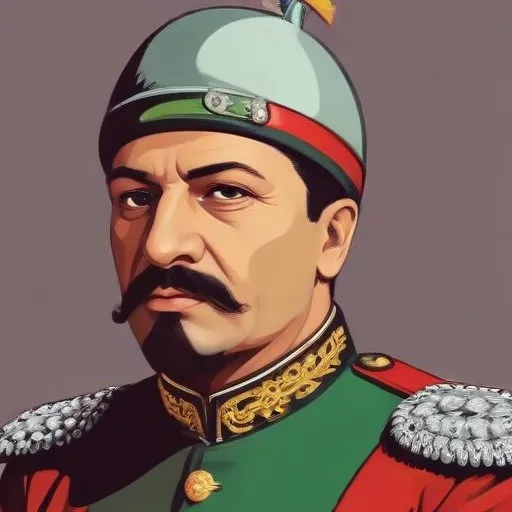
A skilled military leader and statesman who served as the Grand Vizier of the Ottoman Empire, playing a crucial role in the empire's modernization and reform efforts. He is remembered for his efforts to transform the empire into a modern, constitutional state.
Ahmet Tevfik Pasha, a statesman of Crimean Tatar origin, is famously known for being the last Grand Vizier of the Ottoman Empire, serving three terms in office from 1909 to 1922. His remarkable career spanned over four decades, during which he held various high-ranking positions, including diplomat, Senator, and Minister of Foreign Affairs.
Ahmet Tevfik was born on February 11, 1845, in Constantinople to Ferik Ismail Hakk Pasha, a Crimean Tatar descended from the Giray dynasty. His father, a participant in the 1877-1878 Russo-Turkish War, instilled in him a strong sense of duty and service to the empire.
Ahmet Tevfik began his career in military service but soon transitioned to government bureaucracy training. After 1872, he held various foreign ministry posts, serving as an ambassador in Rome, Vienna, St. Petersburg, and Athens. His diplomatic prowess earned him the position of Ottoman chargé d'affaires and ambassador to Germany in Berlin from 1885 to 1895.
Upon returning to Istanbul, Ahmet Tevfik served as the Minister of Foreign Affairs (Hariciye Nazır) from 1899 to 1909. Following the proclamation of the Second Constitutional Era in 1908, he was appointed to a seat in the revived Senate of the Ottoman Empire (Ayan Meclisi), the upper house of the parliament.
Ahmet Tevfik's first term as Grand Vizier (1909-1910) was a direct outcome of the failed counter-revolutionary 31 March Incident. He would go on to serve two more terms, from 1918 to 1919 and from 1920 to 1922, during the Allied occupation of Istanbul under Sultan Mehmed VI.
Ahmet Tevfik Pasha's remarkable career spans the twilight years of the Ottoman Empire, navigating the complex landscape of Ottoman politics and international diplomacy. As the last Grand Vizier, he played a crucial role in shaping the empire's response to the Allied occupation and the eventual collapse of the empire.
Ahmet Tevfik Pasha's legacy extends beyond his remarkable career as a statesman. He played a significant role in shaping the modern Turkish state, and his diplomatic efforts continue to influence Turkey's relations with the international community.
Born in 1642
The Ottoman sultan who ruled from 1648 to 1687, known for his military campaigns that expanded the empire's borders, including the conquest of Crete and parts of Poland. He was also known for his cultural and architectural achievements, including the construction of several mosques and palaces.
Born in 1881
Ottoman Empire's Minister of War and leader of the Young Turk revolution, known for his role in World War I and the Armenian Genocide.
Born in 1872
An Ottoman general who served as the Minister of Navy during World War I, known for his brutal suppression of Arab nationalism and his role in the Armenian Genocide.
Born in 1881
Founder of modern Turkey, leading the country's transition from the Ottoman Empire to a secular, democratic nation, and implementing sweeping reforms in education, law, and women's rights.
Born in 1876
A Turkish field marshal and politician who served as Prime Minister of the Turkish Provisional Government, playing a crucial role in the country's transition from Ottoman Empire to modern republic. He's known for his military victories and political leadership during a tumultuous period in Turkish history.
Born in 1882
A Turkish general and politician who played a key role in the country's War of Independence and later served as the 5th Speaker of the Grand National Assembly of Turkey. He's known for his military victories and contributions to modern Turkey's foundation.
