


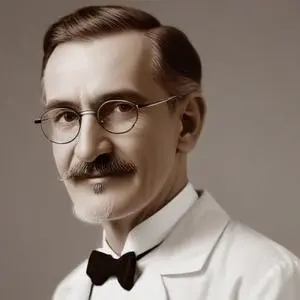
A pioneering physicist who made groundbreaking measurements of the speed of light, leading to fundamental changes in our understanding of space and time.
Albert Abraham Michelson, a pioneer in the realm of physics, is renowned for his groundbreaking experiments that measured the speed of light with unprecedented accuracy. His tireless pursuits led to the development of the Michelson-Morley experiment, a landmark study that challenged the long-held concept of ether and laid the foundation for modern relativity.
Born on December 19, 1852, in Strzelno, Poland, Michelson grew up in a Jewish family that immigrated to the United States when he was just two years old. He spent his childhood in Virginia City, Nevada, and San Francisco, California, before enrolling in the United States Naval Academy in 1869. Michelson graduated in 1873 and went on to serve in the Navy for several years, during which he developed a deep fascination with science and mathematics.
In 1879, Michelson began his academic career at the University of Berlin, where he worked under the guidance of Hermann von Helmholtz. It was during this period that he developed an interest in the measurement of the speed of light, a topic that would consume him for the rest of his life. Michelson's early experiments, though plagued by inconsistent results, laid the groundwork for his later work with Edward Morley.
In 1887, Michelson and Morley collaborated on a series of experiments aimed at detecting the presence of ether, a hypothetical substance thought to be the medium through which light waves propagated. The duo's innovative use of an interferometer allowed them to measure the speed of light with remarkable precision, ultimately leading to the conclusion that ether did not exist. This finding fundamentally challenged the long-held concept of absolute time and space, paving the way for Albert Einstein's theory of special relativity.
Michelson's contributions to science were recognized with numerous accolades, including the Copley Medal in 1907, the Rumford Prize in 1888, and the Henry Draper Medal in 1903. He was also awarded the Nobel Prize in Physics in 1907, the first American to receive the honor.
Michelson married Margaret McLean in 1880, and the couple had two sons and a daughter together. He passed away on May 9, 1931, at the age of 78, leaving behind a legacy that continues to shape our understanding of the universe.
"The more important fundamental laws and facts of physical science have all been discovered, and these are now so firmly established that the possibility of their being supplemented, in consequence of new discoveries, is exceedingly improbable."
Michelson's groundbreaking work continues to influence modern physics, inspiring generations of scientists to push the boundaries of human knowledge. His untiring pursuit of precision and his refusal to accept the status quo have cemented his place as one of the greatest physicists of the 20th century.
Michelson's work not only revolutionized our understanding of the speed of light but also opened the door to a new era of scientific inquiry. His pioneering spirit and relentless pursuit of precision have inspired countless scientists, cementing his place as one of the most influential figures in the history of physics.
Born in 1879
A brilliant physicist who developed the theory of relativity and is considered one of the most influential scientists of the 20th century, known for his groundbreaking work in physics and mathematics.
Born in 1885
A pioneer in quantum mechanics, he introduced the concept of wave-particle duality, revolutionizing our understanding of atomic structure. His philosophical approach to science also explored the nature of reality and human understanding.
Born in 1901
A pioneer in quantum mechanics, he formulated the uncertainty principle, which revolutionized our understanding of the atomic world. His groundbreaking work reshaped modern physics.
Born in 1867
A pioneering scientist who pioneered radioactivity research, discovering elements polonium and radium, and paving the way for breakthroughs in medicine and energy.
Born in 1859
A pioneer in radioactivity research, discovering elements like polonium and radium, and pioneering radioactive isolation techniques. Their groundbreaking work paved the way for advancements in medicine, energy, and materials science.
Born in 1852
Discovered radioactivity, a fundamental property of atoms, and pioneered research in the field, leading to breakthroughs in medicine, energy, and materials science.
Born in 1856
Discovered the electron and developed the plum pudding model of the atom, revolutionizing our understanding of atomic structure.
