


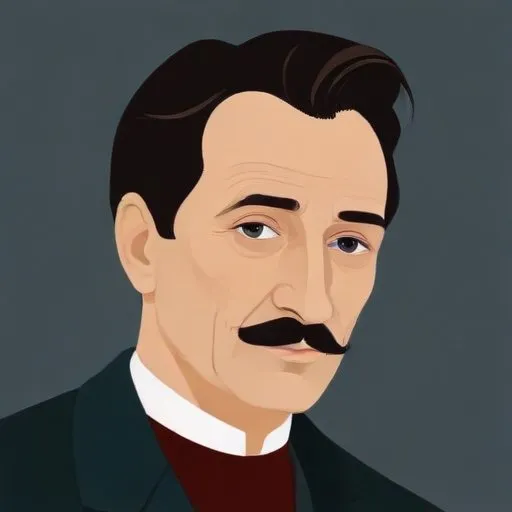
A Hungarian writer and translator, he played a significant role in introducing Western literature to Hungarian readers, and his translations of prominent works remain influential to this day.
Albert Szenczi Molnr, a Hungarian Calvinist pastor, linguist, philosopher, poet, religious writer, and translator, is renowned for his pioneering work in creating Latin-Hungarian dictionaries, which remained in use for centuries. His most notable contributions include the Dictionarium Latinovngaricvm and Dictionarivm VngaricoLatinvm, published in 1604, which defined literary and scientific terminology in the Hungarian language for the first time.
Born on August 30, 1574, in Szenc, Slovakia, Molnr's family was of nobility, with his great-grandfather fighting in the siege of Naples as a soldier of Matthias Corvinus. His father, a mason and miller, was relatively wealthy, but the family soon fell into poverty after his death. Despite the financial struggles, Molnr's family emphasized education, and he went on to study in Wittenberg, Strassburg, Heidelberg, Altdorf, Marburg, and Oppenheim.
Molnr's Latin-Hungarian dictionaries were a monumental achievement, providing a comprehensive guide for Hungarians to learn Latin and vice versa. His work not only facilitated communication between Hungary and the rest of Europe but also helped standardize the Hungarian language. The dictionaries underwent several revisions and remained in use until the first half of the 19th century. Moreover, his Hungarian grammar, Nova Grammatica Ungarica, published in Latin, served as a guidebook until the 18th century, contributing significantly to the unification of Hungarian language and spelling.
In addition to his linguistic contributions, Molnr was a prolific writer of religious texts, translating the Psalms, revising the Vizsoly Bible, and working on John Calvin's Institutes of the Christian Religion and the Heidelberg Catechism. His translations and revisions remain an integral part of Hungarian literary heritage. Molnr's poetry, though lesser-known, showcases his mastery of language and reflects his deep understanding of Hungarian culture and traditions.
Albert Szenczi Molnr's work had a profound impact on Hungarian literature, poetry, and language. He is often regarded as the father of Hungarian lexicography, and his dictionaries and grammar books remain essential references for scholars and linguists. His contributions to Hungarian language and culture have inspired generations of writers, poets, and thinkers. As a pioneer in the field of linguistics, Molnr's work continues to influence Hungarian language and literature to this day.
Despite his achievements, Molnr's personal life was marked by hardships, including poverty and loss. However, he remained dedicated to his work, driven by a passion for language and a desire to serve his country. Through his letters, we gain insight into his personality, which was characterized by humility, diligence, and an unwavering commitment to his craft.
This quote, taken from one of his letters, showcases Molnr's dedication to his country and his desire to make a meaningful contribution to Hungarian language and culture.
Albert Szenczi Molnr's contributions to Hungarian language, literature, and culture are immeasurable. His work has left an indelible mark on the country's intellectual and cultural heritage. As a testament to his legacy, his dictionaries, grammar books, and translations continue to inspire scholars, writers, and linguists today.
Born in 1900
A Hungarian journalist and author, known for his lyrical and introspective novels that explore the decline of the Austro-Hungarian Empire and the rise of fascism. His works are celebrated for their poetic prose and nuanced character studies.
Born in 1885
A Hungarian literary mastermind, celebrated for his innovative, psychologically nuanced novels and poetry that probed the human condition, often with a touch of irony and humor.
Born in 1887
A Hungarian literary giant, known for his witty, satirical writings and pioneering the concept of "six degrees of separation" in his 1929 short story "Chains".
Born in 1901
A Hungarian dentist who wrote plays and books, known for his literary works that explored themes of social justice and morality. His writings often critiqued the social norms of his time.
Born in 1885
A Hungarian philosopher and critic who developed Marxist theory and critiqued capitalism, known for his ideas on reification and the role of class consciousness in shaping society.
Born in 1905
A Hungarian poet and educator, known for his powerful and expressive works that explored themes of social justice, love, and the human condition. His poetry is celebrated for its lyricism and depth.
