


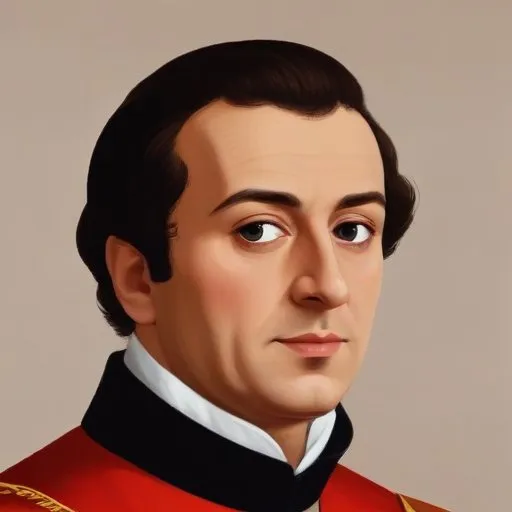
A 16th-century Italian nobleman and military leader, known for his bravery and strategic prowess in battles, particularly during the Italian Wars. He was also a patron of the arts, supporting notable artists and writers.
Alberto d'Este, Marquis of Ferrara, is renowned for his unwavering patronage of the arts, his innovative spirit, and his role in shaping the cultural landscape of 15th-century Italy. As a member of the esteemed Este family, he leveraged his wealth and influence to foster a cultural renaissance in Ferrara, attracting some of the most brilliant minds of the era.
Born in 1475, Alberto d'Este was the son of Ercole I d'Este, Duke of Ferrara, and Eleanor of Naples. His early life was marked by a rich cultural heritage, with his family's court renowned for its magnificence and intellectual pursuits. Alberto's education was entrusted to some of the finest scholars of the time, including the humanist and poet, Pico della Mirandola.
Alberto's most enduring legacy lies in his role as a patron of the arts. He attracted an array of talented artists, writers, and philosophers to his court, including the likes of Ariosto, Boiardo, and Giovanni Bellini. His patronage enabled the creation of some of the most iconic works of the Renaissance, including Ariosto's Orlando Furioso and Bellini's Feast of the Gods.
Alberto's vision for Ferrara extended beyond the realm of art and literature. He embarked on an ambitious program of urban renewal, commissioning grand architectural projects that transformed the city's landscape. His most notable achievement was the construction of the Palazzo Costabili, a masterpiece of Renaissance architecture that remains a testament to his innovative spirit.
Alberto's cultural legacy has had a profound impact on modern society. His patronage of the arts helped shape the Renaissance, an era that continues to inspire artistic innovation and intellectual curiosity. His commitment to urban planning and architecture has influenced the development of cities worldwide, while his support for humanist ideals has contributed to the evolution of Western thought.
Alberto's intellectual pursuits were deeply rooted in humanist philosophy, which emphasized the potential of human beings to achieve great things through education, reason, and individualism. He believed in the power of art and literature to inspire and educate, as well as to promote moral and civic virtue.
"The arts are the lifeblood of our civilization, and it is our duty to nurture and support them, that they may flourish for generations to come."
Alberto d'Este's life and legacy are inextricably linked to the cultural and intellectual ferment of the Renaissance. His commitment to the arts, architecture, and humanist ideals has left an indelible mark on Western culture, earning him a place among the most visionary patrons of the era.
While contemporaries like Lorenzo de' Medici and Pope Julius II were notable patrons of the arts, Alberto's unique blend of cultural vision, architectural innovation, and humanist ideals sets him apart as a truly Renaissance figure.
Alberto's close friendship with Pico della Mirandola, a renowned philosopher and humanist, was instrumental in shaping his intellectual pursuits and cultural vision. The two men shared a deep passion for classical learning and a commitment to promoting the arts and literature.
Alberto's cultural legacy has inspired numerous artistic and literary works, from operas to novels, ensuring his place in the collective imagination of Western culture. His patronage of Ariosto's Orlando Furioso has made him a celebrated figure in literary history.
Through his unwavering commitment to the arts, architecture, and humanist ideals, Alberto d'Este, Marquis of Ferrara, has left an indelible mark on the cultural fabric of Western civilization, inspiring generations of artists, writers, and thinkers to come.
Born in 1452
Ruler of Milan who commissioned Leonardo da Vinci's famous painting, The Last Supper, and was a patron of the arts and architecture.
Born in 1444
The ruler of Milan from 1466 to 1476, known for his cruel and tyrannical reign, marked by numerous assassinations and brutal suppression of opposition. He was also a patron of the arts, commissioning works from famous artists like Leonardo da Vinci.
Born in 1449
A 15th-century noblewoman who played a significant role in shaping the politics and culture of Savoy through her strategic marriages and patronage of the arts. She was a powerful and influential figure in her time, known for her intelligence, beauty, and strong will.
Born in 1480
The illegitimate child of a powerful pope, known for her ruthless politics, alleged poisonings, and scandalous marriages that shaped the Italian Renaissance.
Born in 1431
Ruthless and cunning, this Pope was infamous for his corrupt and immoral ways, using his power to further his family's interests.
Born in 1423
King of Naples who ruled from 1458 to 1494, known for his military campaigns and cultural achievements, including patronizing artists and writers.
