


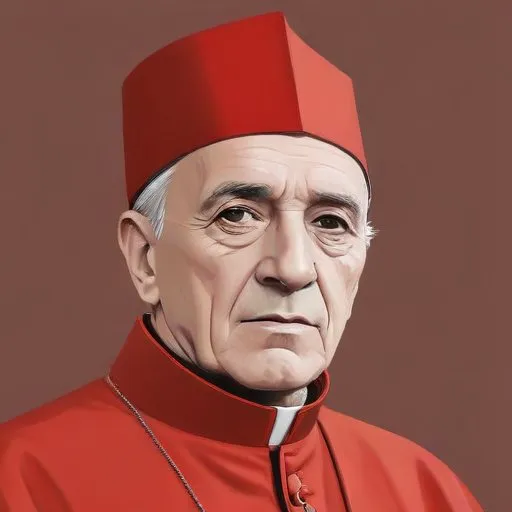
A high-ranking Catholic Church official who served as the Secretary of the Cardinal College and played a key role in the Vatican's financial administration. He was also a close advisor to Pope Pius XII.
Cardinal Alberto di Jorio was the mastermind behind the Vatican's growing wealth, alongside Bernardino Nogara, a layman. For many years, he played a pivotal role in shaping the financial empire of the Catholic Church, earning him the reputation as the powerhouse behind the Vatican Bank.
Born on July 18, 1884, in Rome, Italy, Alberto di Jorio was destined for a career in the Roman Curia. He attended the prestigious Pontifical Roman Seminary and became a priest in 1908. Shortly after, he took up a role as an official in the vicariate of Rome, eventually becoming an expert in the Vatican bureaucracy.
In 1918, di Jorio became the president of the Istituto per le Opere di Religione (Institute for Works of Religion), a position that would catapult him to prominence. Under the direction of Pope Pius XI, di Jorio formed a close association with Bernardino Nogara in the 1920s. This partnership would prove instrumental in shaping the Vatican's financial future.
The Lateran Treaty of 1929 settled the Roman Question, making the Vatican an independent state. This historic event paved the way for the Vatican's immense wealth growth, with di Jorio at the helm. He, along with Nogara, exploited laws that allowed them to freely invest in companies, even if their business activities didn't align with Catholic Church teachings. This led to the Vatican acquiring extensive shares in corporations like General Motors, Standard Oil, General Electric, and IBM, as well as Italgas, Italy's major gas supplier.
Di Jorio continued to run the Istituto per le Opere di Religione until after Vatican II. He also played various roles in the Curia, including serving as Secretary of the College of Cardinals in 1947. In this capacity, he was secretary of the 1958 conclave that elected Pope John XXIII.
Cardinal Alberto di Jorio's legacy is marked by his instrumental role in shaping the Vatican's financial empire. His association with Nogara and his leadership of the Istituto per le Opere di Religione had a profound impact on the Catholic Church's wealth and influence. Although his career was marked by controversy, his contributions to the Church's financial standing cannot be overstated.
Despite the controversies surrounding his career, Cardinal Alberto di Jorio remains an important figure in the history of the Catholic Church. His role in shaping the Vatican's financial empire has had a lasting impact on the Church's influence and wealth.
Born in 1876
The leader of the Catholic Church from 1939 to 1958, known for his controversial role during World War II, particularly in regards to the Holocaust. He is also remembered for his encyclicals on social justice and liturgical reforms.
Born in 1881
Reformed the Catholic Church, introducing progressive reforms and ecumenical dialogue, and convened the Second Vatican Council.
Born in 1417
A 15th-century pope who played a significant role in the fall of the Western Schism, ending the division in the Catholic Church. He's also known for his lavish spending and nepotism.
Born in 1920
Leader of the Catholic Church from 1978 to 2005, known for helping to end communism in Poland and being a charismatic advocate for human rights and social justice.
Born in 1920
Leader of the Catholic Church from 1978 to 2005, known for helping to end communism in Poland and being a charismatic advocate for human rights and social justice.
Born in 1879
A German nobleman who served as Chancellor of Germany in 1932, known for his role in appointing Adolf Hitler as Chancellor, paving the way for the Nazi regime.
