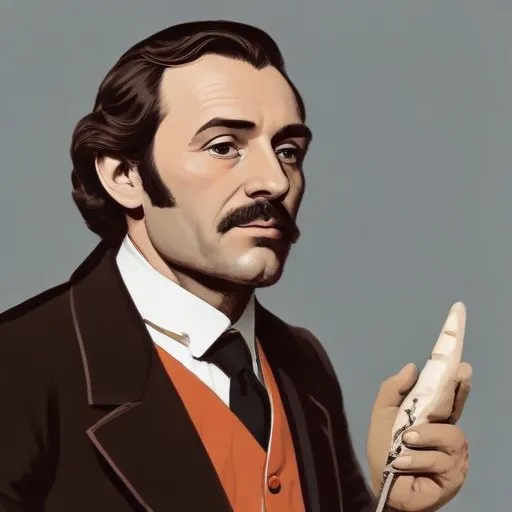
Alcide d'Orbigny: A Pioneering French Naturalist
Contributions to Zoology and Beyond
Alcide d'Orbigny was a renowned French naturalist who left an indelible mark on various fields, including zoology, malacology, palaeontology, geology, archaeology, and anthropology. He is particularly known for his extensive research on foraminiferans, a group of microscopic marine organisms that he was the first to describe.
Early Life and Education
Born on September 6, 1802, in Couronne, Loire-Atlantique, France, d'Orbigny was the son of a ship's physician and amateur naturalist. The family's relocation to La Rochelle in 1820 had a profound impact on d'Orbigny's life, as it was there that he developed a passion for natural history, particularly the study of marine fauna.
Influences and Mentorship
In Paris, d'Orbigny became a disciple of the geologist Pierre Louis Antoine Cordier and
Georges Cuvier, two prominent figures in the scientific community. He was deeply influenced by Cuvier's theories and maintained a strong opposition to Lamarckism throughout his career.
South American Expeditions
Between 1826 and 1833, d'Orbigny embarked on a mission for the Paris Museum, traveling extensively throughout South America. He visited Venezuela, Colombia, Ecuador, Peru, Bolivia, Chile, Argentina, Paraguay, and Brazil, collecting an enormous repository of over 10,000 natural history specimens. His findings were later documented in the multi-volume work,
La Relation du Voyage dans l'Amérique Méridionale pendant les années 1826-1833.
Correspondence with Charles Darwin
Interestingly,
Charles Darwin arrived in South America in 1832, only to discover that d'Orbigny had preceded him. Despite this, the two naturalists maintained a cordial correspondence, with d'Orbigny even describing some of Darwin's specimens. Darwin later acknowledged the significance of d'Orbigny's work, referring to his
Voyage as "a most important work."
Awards and Recognition
In 1834, d'Orbigny was awarded the Gold Medal of the Société de Géographie of Paris. Additionally, the South American Paleocene pantodont
Alcidedorbignya was named in his honor.
Later Career and Contributions
In 1840, d'Orbigny began a systematic description of French fossils, culminating in the publication of
La Paléontologie Française, an eight-volume work. He later published
Prodrome de Paléontologie Stratigraphique in 1849, a closely related study.
Legacy
Alcide d'Orbigny's contributions to the natural sciences have had a lasting impact on our understanding of the natural world. His work continues to inspire and inform researchers across various disciplines, ensuring his legacy as a pioneering French naturalist.
- La Relation du Voyage dans l'Amérique Méridionale pendant les années 1826-1833
- La Paléontologie Française (8 vols.)
- Prodrome de Paléontologie Stratigraphique
FAQ
What were Alcide dOrbignys contributions to zoology?
Alcide dOrbigny was a French zoologist who made significant contributions to the field of zoology, particularly in the study of mollusks. He described over 1,000 new species and wrote several influential works on the subject.
What is Alcide dOrbignys significance in the field of geology?
Alcide dOrbigny was also a geologist who made important contributions to the field, including the discovery of fossilized shells in South America. His work helped to shed light on the geological history of the continent.
What was Alcide dOrbignys role in the development of paleontology?
As a paleontologist, Alcide dOrbigny played a key role in the development of the field, particularly in the study of fossils. He was one of the first scientists to recognize the importance of fossils in understanding the history of life on Earth.
What were Alcide dOrbignys travels like?
Alcide dOrbigny traveled extensively throughout South America, where he collected numerous specimens and made important discoveries about the regions geology and wildlife.
What is Alcide dOrbignys legacy in science?
Alcide dOrbignys work had a lasting impact on the fields of zoology, geology, and paleontology. He is still remembered today as one of the most important scientists of the 19th century.