


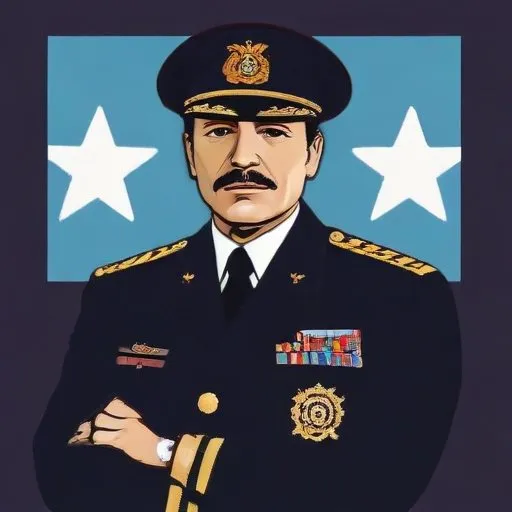
Leader of the Carapintadas, a group of Argentine military officers who rebelled against the government in the 1980s and 1990s, known for his role in shaping Argentina's transition to democracy.
Aldo Rico is famously known for his role in the 1987 Semana Santa and 1988 Monte Caseros mutiny, where sectors of the Argentine Armed Forces, known as carapintadas (painted faces), revolted against the policies of President Raúl Alfonsín. This marked a significant event in Argentine history, showcasing Rico's influence on the country's political landscape.
Aldo Rico was born on March 4, 1943, in Buenos Aires, Argentina. He joined the Argentine Army, eventually becoming a commander of the 602 Commando Company during the 1982 Falklands War. After the war, Rico achieved the rank of lieutenant colonel and began to agitate against the prosecution of crimes against humanity committed by the 1976-1983 juntas.
In 1987, Rico and his followers, known as carapintadas, took up arms during Easter week, making a series of demands to the government. The Argentine public, still sensitive to military interventions, rallied around President Alfonsín, who agreed to consider the demands. This episode, although bloodless, weakened the president's image and paved the way for future military uprisings. Rico was sentenced to house arrest but escaped in 1988 and led a second armed episode, resulting in his imprisonment.
After being pardoned by President Carlos Menem in 1989, Rico shifted his focus to electoral politics. He created the MODIN party (Movimiento por la Dignidad Nacional, or Movement for National Dignity) and occupied several elective offices, including being elected mayor of San Miguel from 1997 to 2003 and Minister of Police of Buenos Aires province for a short period in 1999.
Rico's legacy is marked by controversy, with some viewing him as a champion of Argentine nationalism and others seeing him as a threats to democracy. His role in the Carapintada uprising and his subsequent entry into politics have sparked intense debates about the role of the military in Argentine politics.
Rico's actions have had a lasting impact on modern Argentine society, influencing the country's political landscape and sparking debates about the role of the military in politics. His legacy continues to be felt, with many regarding him as a polarizing figure in Argentine history.
Despite the controversies surrounding his career, Aldo Rico remains a significant figure in Argentine history, with his actions continuing to shape the country's political landscape.
Born in 1925
A ruthless military dictator who ruled Argentina from 1976 to 1981, notorious for human rights abuses and disappearances during the Dirty War.
Born in 1924
A military leader who briefly ruled Argentina during a tumultuous period, known for his role in the country's transition from dictatorship to democracy.
Born in 1926
The 44th President of Argentina, a military dictator who led the country during the Falklands War, is known for his authoritarian rule and disastrous foreign policy decisions.
98 Years Old
The last dictator of Argentina's military junta, known for his brutal regime and human rights abuses during the Dirty War. He was later convicted of crimes against humanity.
