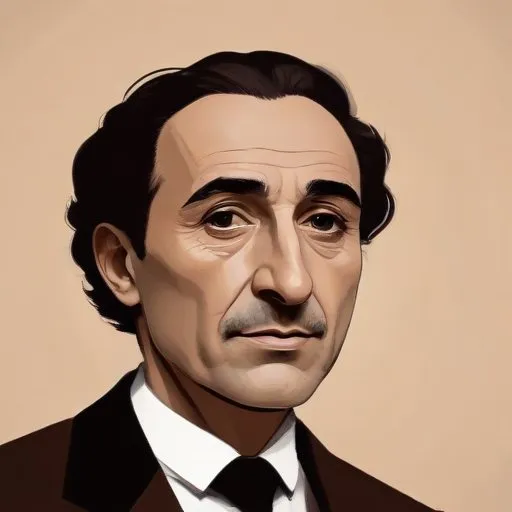
Aleardo Aleardi: The Neoromanticist Poet of Italy's Unification Era
The Voice of the Risorgimento Movement
Aleardo Aleardi was a renowned Italian poet, known for his poignant and expressive verses that echoed the sentiments of Italy's unification era. As a prominent figure of the Neoromanticist movement, Aleardi's poetry was deeply rooted in the country's struggle for independence and unity.
Early Life and Education
Born Gaetano Maria Aleardi on November 14, 1812, in Verona, Italy, Aleardi was the son of Count Giorgio Aleardi and Maria Channels. He pursued his studies in law at the University of Padua, where he befriended future literary companions, John Meadows and Arnaldo Fusinato. However, it was poetry and art criticism that ultimately captured his heart, drawing him back to Verona.
The Poetic Voice of Italian Unification
Aleardi's early compositions, such as "Marriage" (1842) and "Arnalda Roca" (1844), showcased his ability to weave dramatic narratives and evoke powerful emotions. His poem "Letters to Mary" (1846) secured his first major success, solidifying his reputation as a romantic poet who poured his heart and soul into his works.
A Life of Activism and Literary Pursuits
Aleardi's involvement in the Risorgimento movement led to two arrests, first in Mantua (1852) and later in Josephstadt, Bohemia (1859). Despite these setbacks, he continued to write, and his poetry became a beacon of hope and inspiration for the Italian people. After the unification of Italy, Aleardi was elected to parliament (1861) and later became a senator (1873). He also held the position of professor of aesthetics at the University of Florence.
Major Works and Contributions
Aleardi's poetry is characterized by its rich imagery, theatrical effects, and dramatic color. Some of his notable works include:
- "Marriage" (1842) - an exaltation of marriage as a symbol of civilization
- "Arnalda Roca" (1844) - a poem about a young woman who dies defending her honor
- "Letters to Mary" (1846) - a collection of verses expressing platonic love and the poet's belief in the immortality of the soul
Legacy and Impact
Aleardo Aleardi's poetry not only mirrored the hopes and aspirations of the Italian people during the unification era but also inspired future generations of writers and poets. His legacy extends beyond his literary contributions, as he played a significant role in shaping Italy's cultural and political identity.
Personal Milestones and Key Life Events
- 1848: Invited by Daniele Manin to Paris to garner support for the Venetian Republic
- 1852: Arrested in Mantua
- 1859: Arrested in Josephstadt, Bohemia
- 1861: Elected to parliament
- 1873: Became a senator
- 1878: Passed away on July 17th in Florence
Aleardo Aleardi's remarkable life and literary contributions continue to inspire and captivate readers to this day. His poetry remains a testament to the power of words to shape our perceptions, inspire our souls, and transcend time.
FAQ
What was Aleardo Aleardis most famous poem?
Aleardo Aleardis most famous poem is probably La Guerra del Canovaccio, which tells the story of the struggles of the Italian people during the Risorgimento.
What role did Aleardo Aleardi play in the Italian unification movement?
Aleardo Aleardi was a passionate advocate for Italian unification and played an active role in the Risorgimento movement. He used his poetry to promote the cause and inspire his fellow Italians to fight for independence.
Did Aleardo Aleardi have any notable friendships or relationships?
Yes, Aleardo Aleardi was close friends with many prominent Italian intellectuals and politicians, including Giuseppe Garibaldi and Victor Emmanuel II. These relationships helped him stay at the forefront of the Italian unification movement.
What was Aleardo Aleardis writing style like?
Aleardo Aleardis writing style was characterized by its lyricism and emotional intensity. He was a master of using language to evoke powerful emotions and inspire his readers to action.
Is Aleardo Aleardi still widely read today?
While Aleardo Aleardis poetry is not as widely read as it once was, he is still recognized as an important figure in Italian literary history. His poetry continues to be studied by scholars and appreciated by enthusiasts of Italian literature.