


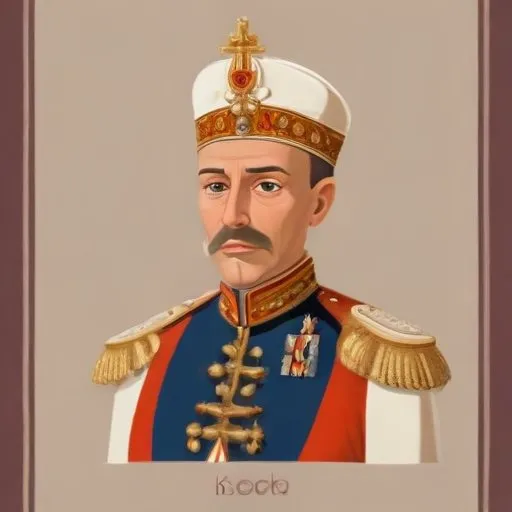
A medieval Russian grand prince who ruled Tver and briefly Vladimir-Suzdal, known for his attempts to unite Russian principalities against the Mongol Golden Horde. He was a key figure in medieval Russian politics.
Aleksandr Mikhailovich of Tver, the Russian prince who ruled Tver and Vladimir, is remembered for his courageous stand against the Mongol Empire and his martyrdom at the hands of the Tatars in 1339. His reign was marked by the Tver Uprising, a pivotal event that would forever change the course of Russian history.
Aleksandr Mikhailovich was born on October 7, 1301, as the second son of Prince Mikhail of Tver and his wife, Anna of Kashin. As a young man, he received the appanages of Kholm and Mikulin, and was groomed to take up the mantle of leadership.
In 1322, Aleksandr continued the Tver princes' opposition to the rise of Moscow when he waylaid Grand Prince Yury of Moscow, who had schemed against Aleksandr's father to gain the yarlyk (patent of office) from the khan of the Golden Horde. This bold move marked Aleksandr's entry into the complex web of power struggles between the Russian princes and the Mongol Empire.
In 1327, a Tatar official, Shevkal, arrived in Tver with a large retinue, taking up residence at Aleksandr's palace. The Tatars' brutal behavior sparked widespread unrest, culminating in a mob attack that killed Shevkal and his guards. This event, known as the Tver Uprising, would have far-reaching consequences for Aleksandr and the people of Tver.
In 1339, Aleksandr was summoned to the Mongol capital, Sarai, where he was executed, along with his son Fyodor, on the orders of the khan. This brutal act of reprisal marked the end of Aleksandr's reign, but it also cemented his status as a martyr and a symbol of resistance against the Mongol Empire.
Aleksandr Mikhailovich of Tver's life and reign were shaped by the complex dynamics of power struggles between the Russian princes and the Mongol Empire. His courageous stand against the Tatars, and his ultimate martyrdom, have made him an enduring symbol of resistance and patriotism in Russian history.
Aleksandr's life and reign can be compared to that of Ivan Kalita of Moscow, who capitalized on the power vacuum created by the Tver Uprising to consolidate his own power. While Ivan's cunning and pragmatism secured his position, Aleksandr's bravery and conviction ultimately led to his downfall.
Aleksandr Mikhailovich of Tver's legacy continues to inspire and educate Russians today, serving as a powerful symbol of national identity and resistance against foreign occupation. His story has been immortalized in literature, art, and popular culture, ensuring his place in the pantheon of Russian heroes.
Born in 1371
Grand Prince of Moscow who ruled from 1389 to 1425, known for strengthening Moscow's power and establishing it as the center of the Russian Orthodox Church.
Born in 1371
Grand Prince of Moscow who ruled from 1389 to 1425, known for strengthening Moscow's power and establishing it as the center of the Russian Orthodox Church.
Born in 1440
Unified Russia, ended Mongol rule, and established the Russian Orthodox Church as a major power.
Born in 1479
Grand Prince of Moscow who consolidated power, annexed neighboring regions, and established the foundations for the Russian state, known for his centralizing policies and territorial expansion.
Born in 1666
The last of the weak and ineffective rulers of the House of Romanov, known for being mentally disabled and used as a puppet by his sister Sophia, who ruled in his place.
