


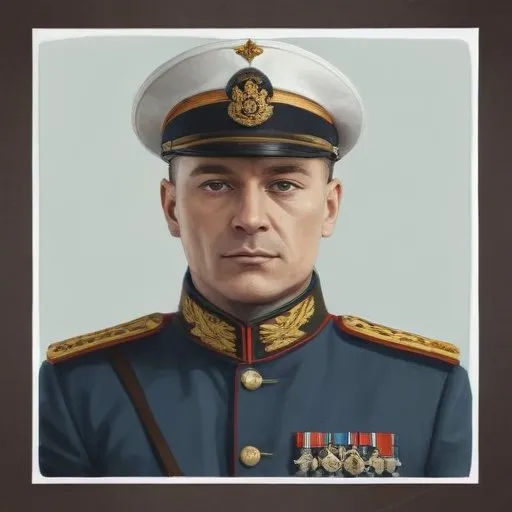
A Soviet submarine commander who sank the German ship Wilhelm Gustloff, resulting in the deadliest maritime disaster in history. He's a hero in Russia and a controversial figure in the West.
Alexander Marinesko, a Soviet career naval officer, etched his name in history as the captain of the submarine S-13, which torpedoed and sank the German military transport ship Wilhelm Gustloff in the Baltic Sea on January 30, 1945, resulting in one of the deadliest maritime disasters in history. With over 9,300 lives lost, Marinesko's bravery and tactical prowess cemented his status as a war hero, despite a tumultuous personal life and professional controversies.
Born on January 15, 1913, in Odessa, Marinesko was the son of a Romanian sailor, Ion Marinescu, and a Ukrainian mother, Tatiana Mihailovna Koval. His father's past troubles had led him to flee to the Russian Empire, where he adopted the surname "Marinesko" according to Russian-Ukrainian language conventions.
A young Marinesko trained in the Soviet Merchant Navy and the Soviet Navy's Black Sea Fleet. He was appointed commander of the submarine M-96 in the summer of 1939, which entered service in mid-1940 and was declared the best submarine of the Baltic Fleet. His exceptional service earned him a golden watch and a promotion to captain-lieutenant in 1940.
Marinesko's most notable achievement came during World War II, when he commanded the submarine S-13. On January 30, 1945, the S-13 torpedoed and sank the Wilhelm Gustloff, a German military transport ship carrying civilians, women, and children being evacuated from East Prussia, in addition to military personnel. The sinking resulted in an estimated 9,300 deaths, making it one of the deadliest maritime disasters in history.
Despite his wartime heroics, Marinesko's personal life was marked by controversy. His rough demeanor and alleged womanizing led to his being deemed "personally unsuitable" for the highest award by the Soviet government. However, in 1990, he was posthumously awarded the title of Hero of the Soviet Union by President Mikhail Gorbachev, acknowledging his exceptional bravery and contributions to the war effort.
Alexander Marinesko's remarkable career saw him sink 42,000 gross register tons (GRT) of enemy shipping, making him the most successful Soviet submarine commander in terms of GRT sunk.
In recognition of his service, Marinesko was awarded several honors, including the Order of the Red Banner, the Order of the Patriotic War, and the Medal "For the Defence of Leningrad". Posthumously, he was awarded the title of Hero of the Soviet Union, solidifying his place in Soviet history.
Alexander Marinesko passed away on November 25, 1963, leaving behind a complex legacy as a war hero and a troubled individual. Despite his personal controversies, his bravery and exceptional service in the Soviet Navy have cemented his place as one of the most revered and feared submarine commanders in history.
Today, Marinesko's legacy serves as a testament to the sacrifices made during World War II, and his name is forever etched in the annals of Soviet history as a symbol of bravery, tactical genius, and devotion to duty.
Born in 1878
The Soviet Union's ruthless leader who ruled with an iron fist, implementing policies that led to widespread famine and purges, while also playing a crucial role in defeating Nazi Germany in World War II.
Born in 1870
Founder of the world's first socialist state, leading the Bolshevik Revolution and establishing the Soviet Union, known for his radical Marxist ideology and authoritarian rule.
Born in 1896
A Soviet military leader who played a crucial role in defeating Nazi Germany in World War II, and later became a key figure in Soviet politics.
Born in 1896
A Soviet military leader who played a crucial role in several key battles, including the Battle of Stalingrad and the capture of Berlin, earning him the highest military honors. He was a skilled strategist and tactician who helped turn the tide of the war in favor of the Allies.
Born in 1909
Soviet Minister of Foreign Affairs who played a crucial role in shaping the country's foreign policy during the Cold War, known for his diplomatic skills and ability to navigate complex international relations.
Born in 1894
The Soviet leader who initiated reforms and denounced Stalin's regime, known for his bold policies and iconic shoe-banging incident at the UN.
Born in 1906
A Soviet leader who ruled with an iron fist, implementing policies that stagnated the economy and suppressed dissent, while also being a key figure in the Cold War. He's infamous for his authoritarian regime and bureaucratic inefficiency.
95 Years Old
The last leader of the Soviet Union, who introduced reforms that led to the end of the Cold War and the collapse of communism, earning a Nobel Peace Prize. He's known for his policies of glasnost and perestroika, which transformed the Soviet Union and the world.
