


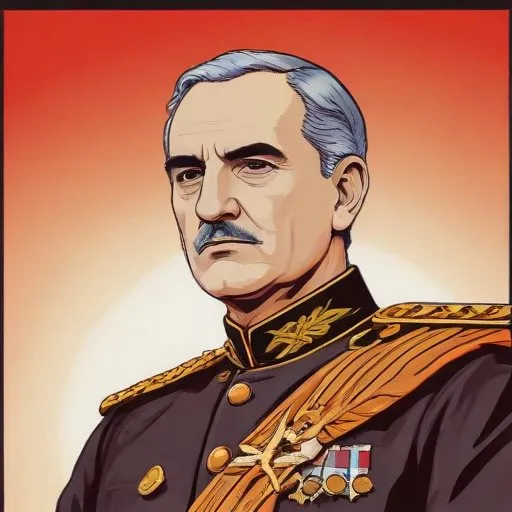
A Greek general and politician who led the country to victory in the Greco-Italian War and later became Prime Minister, implementing policies to stabilize the economy and promote development.
General Alexander Papagos is renowned for his unwavering dedication to Greece's independence and his instrumental role in the country's World War II victory. As a distinguished military leader, he is celebrated for his bravery, strategic genius, and unwavering commitment to the Greek people.
Born on December 9, 1883, in Athens, Greece, Papagos was destined for greatness. He pursued a military career, graduating from the Greek Military Academy in 1906. His early years were marked by service in the Balkan Wars, where he distinguished himself as a capable and courageous officer.
Papagos' rise to prominence began during World War I, where he played a crucial role in the Greek Army's efforts. His exceptional leadership skills and tactical prowess earned him recognition and respect from his peers and superiors alike. In 1935, he was promoted to the rank of Lieutenant General and became the Chief of the Greek General Staff.
When Germany launched its invasion of Greece in 1941, Papagos masterminded the country's defense, leveraging his strategic brilliance to resist the enemy's advances. Despite being vastly outnumbered, the Greek Army under his command inflicted significant casualties on the Axis powers. Although Greece ultimately fell, Papagos' leadership and bravery earned him international acclaim.
Following Greece's defeat, Papagos was exiled to Egypt, where he continued to advocate for Greek independence and resistance against the Axis occupation. He played a pivotal role in organizing and coordinating the Greek Resistance, providing crucial support to the Allied forces.
After the war, Papagos returned to Greece and entered politics, serving as Prime Minister from 1952 to 1955. His leadership focused on rebuilding and modernizing Greece, promoting economic growth, and strengthening the country's international relations. Today, he is revered as a national hero, and his legacy continues to inspire generations of Greeks.
Papagos' leadership philosophy was rooted in his unwavering commitment to his country and its people. He believed in the importance of national unity, dignity, and self-determination, and his actions throughout his life reflected these values.
Papagos' legacy extends beyond his military achievements, as he played a significant role in shaping modern Greece. His commitment to unity, self-determination, and democracy continues to inspire Greeks today, and his leadership has left an indelible mark on the country's history.
"The Greek people will always resist. We will fight to the last man, to the last round of ammunition."
Papagos' courageous words, spoken during the darkest days of World War II, have become an iconic expression of Greek determination and resilience.
Alexander Papagos' remarkable life and career serve as a testament to his unwavering dedication to Greece and its people. His bravery, strategic genius, and leadership have cemented his place as one of Greece's most revered historical figures.
Born in 1918
Greek lawyer and politician who served as the 178th Prime Minister of Greece, known for his efforts to modernize and liberalize the Greek economy. He played a key role in Greece's accession to the European Union.
Born in 1919
Greek economist and politician who served as Prime Minister of Greece, known for his socialist policies and efforts to reduce Greece's reliance on foreign capital. He also played a key role in Greece's accession to the European Union.
Born in 1888
A Greek lawyer, economist, and politician who served as the Prime Minister of Greece from 2009 to 2011, known for his efforts to address the country's debt crisis.
Born in 1864
A Greek statesman who played a crucial role in shaping modern Greece, leading the country through significant reforms and transformations. He's known for his visionary leadership and diplomatic prowess.
Born in 1907
A Greek lawyer and politician who served as President of Greece, known for leading the country's transition from military dictatorship to democracy. He's credited with modernizing Greece and joining the European Union.
Born in 1871
A Greek general and politician who served as the 130th Prime Minister of Greece, known for his authoritarian regime and opposition to the Axis powers during World War II. He implemented a series of reforms and modernization projects, but also suppressed political opposition and civil liberties.
Born in 1918
A Greek lieutenant-turned-politician who served as the 173rd Prime Minister of Greece, known for his brief but tumultuous tenure during a period of political and economic crisis.
Born in 1898
Greek Prime Minister from 1996 to 2004, known for his efforts to reform the Greek economy and prepare the country for the Eurozone. He also played a key role in resolving the Macedonia naming dispute.
