


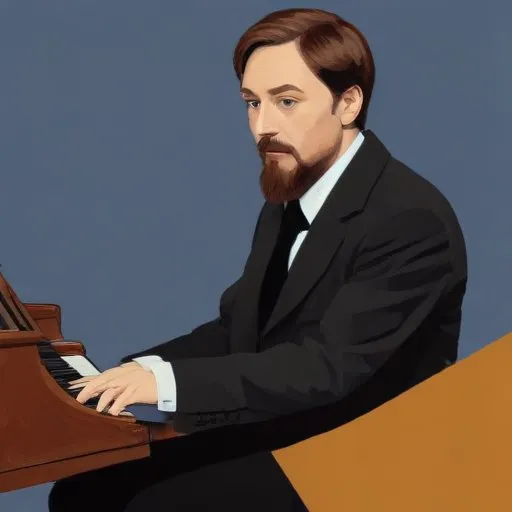
A Russian musical genius who fused mysticism and philosophy with innovative, avant-garde compositions that expanded the boundaries of classical music. His symphonies and piano sonatas are renowned for their complex harmonies and spiritual intensity.
Alexander Scriabin, a Russian composer and virtuoso pianist, is renowned for his innovative and provocative musical style, which transcended traditional tonality and delved into the realms of mysticism and synesthesia. His compositions, characterized by dissonant harmonies and bold experimentation, have inspired generations of musicians and continue to fascinate audiences today.
Born on Christmas Day, 1871, in Moscow, Russia, Scriabin came from a noble family. His early life was marked by a deep passion for music, and he began taking piano lessons at the age of nine. The works of Frédéric Chopin had a profound impact on him, shaping his early compositional style and instilling in him a sense of Romanticism.
As Scriabin's career progressed, he began to move away from the traditional tonal harmony of his early works, instead exploring more dissonant and experimental sounds. This transformation was marked by his fascination with theosophy, a spiritual movement that emphasized the unity of all existence. His music became increasingly characterized by complex harmonies, atonalities, and a sense of mysticism.
One of Scriabin's most intriguing contributions to music was his development of a "color-coded" circle of fifths, which associated specific colors with different harmonic tones. This synesthetic approach to music composition was a testament to his innovative and unconventional thinking.
Scriabin's oeuvre comprises a diverse range of works, including symphonies, piano sonatas, and orchestral pieces. Some of his most notable compositions include:
Scriabin's influence on modern music is undeniable. Composers such as Igor Stravinsky, Sergei Prokofiev, and Karol Szymanowski drew inspiration from his innovative style. Despite a decline in popularity after his death in 1915, Scriabin's music has experienced a resurgence in recent years, with many pianists and conductors championing his works.
As a composer, pianist, and visionary, Alexander Scriabin continues to fascinate and inspire audiences with his bold, mystical, and deeply personal music. His legacy serves as a testament to the power of innovation and creativity in the world of classical music.
"Art is the means of conveying the invisible, the unknown, and the infinite."
"The aims of music are precisely those of mysticism: the awakening of the soul, the redemption of humanity."
These words, spoken by Scriabin himself, provide a glimpse into the mind of a true maverick, whose art continues to inspire and challenge us to this day.
Born in 1873
A renowned Russian musician who composed iconic symphonies and piano concertos, and was also a skilled pianist and conductor, leaving a lasting legacy in classical music.
Born in 1839
A Russian master of evocative and dramatic music, famous for his vivid orchestral works, including the iconic "Night on Bald Mountain" and "Pictures at an Exhibition".
Born in 1844
A Russian master of orchestration, known for his vibrant and exotic compositions, such as "Scheherazade" and "Flight of the Bumblebee", that evoke fantastical worlds and mythical creatures.
Born in 1882
A Russian master of music, renowned for revolutionizing classical music with bold, avant-garde compositions that blended traditional and modern elements. His iconic works, such as "The Rite of Spring," continue to inspire and influence artists across genres.
Born in 1918
A renowned musician who blended jazz, classical, and Broadway styles, creating iconic works like West Side Story, and inspiring generations with his charismatic performances and innovative compositions.
Born in 1891
A Russian musical genius who composed iconic works like "Peter and the Wolf" and "Romeo and Juliet," blending classical and modern styles.
Born in 1906
A renowned Russian pianist and composer, known for blending classical music with dark humor and satire, creating iconic symphonies and film scores that still resonate today.
Born in 1840
A renowned Russian composer and educator, he is best known for his iconic and beloved ballets, such as Swan Lake and The Nutcracker, which continue to enchant audiences worldwide.
