


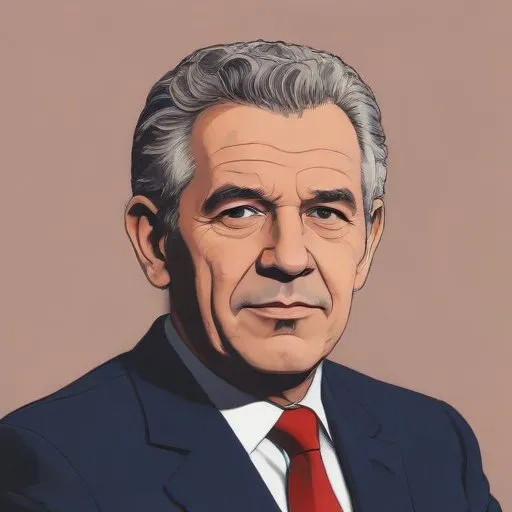
The current President of Austria, a former economics professor and Green Party leader, known for his strong stance on environmental issues and European integration.
Alexander Van der Bellen, the current President of Austria, has made a name for himself as a fierce advocate for green politics and social liberalism. As a professor of economics, a leader of the Austrian Green Party, and eventually, the President of Austria, Van der Bellen has left an indelible mark on the country's political landscape.
Born on January 18, 1944, to Russian and Estonian parents who fled the occupation of the Baltic states, Van der Bellen became a naturalized citizen of Austria in 1958. His ancestral roots can be traced back to the 18th-century Dutch aristocratic family, the Van der Bellens.
Van der Bellen's academic pursuits led him to become a professor of economics at the University of Vienna, where he taught from 1977 to 2009. His expertise in economics and dedication to environmental issues paved the way for his entry into politics.
In 1994, Van der Bellen joined the National Council as a representative of the Green Party, serving until 2012. He later assumed leadership roles within the party, becoming the leader of the parliamentary group and eventually, the spokesperson for the Austrian Green Party.
In 2016, Van der Bellen ran as an independent candidate, backed by the Greens, in the presidential election. Although he faced a re-run due to electoral irregularities, he ultimately won the election with approximately 54% of the vote.
Van der Bellen identifies as a centrist liberal, advocating for green and social liberal policies. He has expressed support for European federalism and has written extensively on the topic in his 2015 book.
As a champion of green politics, Van der Bellen has emphasized the importance of environmental protection, social justice, and human rights. His presidency has focused on promoting sustainable development, mitigating climate change, and fostering a more inclusive society.
As the second Green president of a European Union country, after Raimonds Vjonis of Latvia, Van der Bellen's presidency has set a precedent for green politics in Europe. His commitment to environmentalism and social liberalism has inspired a new generation of politicians and activists.
Van der Bellen's influence extends beyond Austria, as he has become a prominent voice in international debates on climate change, migration, and social justice. His leadership has contributed to a shift in the global conversation, emphasizing the importance of sustainable development and human rights.
Alexander Van der Bellen's presidency marks a significant moment in Austrian history, as he has brought green politics to the forefront of national and international discourse. His commitment to environmentalism, social justice, and human rights has cemented his legacy as a champion of progressive values.
As a leader who has navigated the complexities of modern politics, Van der Bellen's legacy will be remembered for generations to come, inspiring future leaders to prioritize the well-being of the planet and its inhabitants.
40 Years Old
The 25th Chancellor of Austria, a young and charismatic leader who rose to power at 31, known for his anti-immigration stance and efforts to reform the European Union. He's a prominent figure in European politics, especially among the conservative right.
88 Years Old
The 11th President of Austria, a renowned academic and politician, served as the country's head of state from 2004 to 2016, known for promoting unity and stability. He's also a respected historian and law expert.
66 Years Old
The 28th Chancellor of Austria, serving from 2008 to 2016, is most known for his strong stance on European Union policies and his efforts to reform Austria's economy. He played a key role in shaping the country's response to the European sovereign-debt crisis.
85 Years Old
A German-Austrian lawyer and politician who served as the President of the National Council of Austria from 2000 to 2002 and was a key figure in Austrian politics. He's known for his conservative views and leadership roles in Austrian government.
