


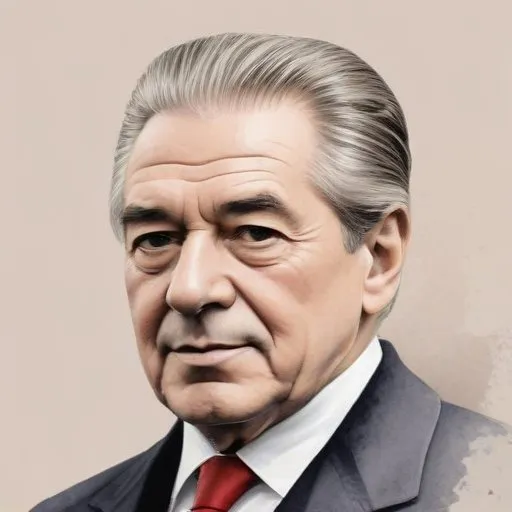
The 11th President of Austria, a renowned academic and politician, served as the country's head of state from 2004 to 2016, known for promoting unity and stability. He's also a respected historian and law expert.
Heinz Fischer, the esteemed Austrian politician, is renowned for his remarkable tenure as President of Austria from 2004 to 2016. Throughout his distinguished career, he has been a beacon of hope for unity and progress, leaving an indelible mark on the country's political landscape.
Fischer was born on October 9, 1938, in Graz, Styria, to a Jewish family amidst the tumultuous backdrop of Nazi Germany's annexation of Austria. Despite the challenges, he excelled academically, graduating from a humanities-focused grammar school in 1956. He then pursued a doctorate in law from the University of Vienna, which he achieved in 1961.
A significant turning point in Fischer's life was his year-long volunteering stint at Kibbutz Sarid in northern Israel in 1963, an experience that shaped his worldview and instilled a deep sense of empathy. This formative experience would later influence his political ideology and commitment to fostering unity.
Fischer's foray into politics began in 1971, when he became a member of the Austrian parliament, the National Council. His dedication and acumen earned him the position of President of the National Council, which he held from 1990 to 2002. During this period, he also served as Minister of Science from 1983 to 1987 in a coalition government led by Fred Sinowatz.
Fischer's academic pursuits did not take a backseat; he became a professor of Political Science at the University of Innsbruck in 1994, further solidifying his reputation as a scholar-politician.
In January 2004, Fischer announced his candidacy for the presidency, succeeding Thomas Klestil. He was elected on April 25, 2004, as the candidate of the opposition Social Democratic Party, polling an impressive 52.4% of the votes. Fischer was sworn in on July 8, 2004, and took office, marking the beginning of a new era in Austrian politics.
Fischer's first term as president was marked by his commitment to unity, social justice, and progressive values. He played a crucial role in bridging the gap between different political factions, fostering a sense of national unity, and promoting Austria's interests on the global stage.
In April 2010, Fischer was re-elected president, winning a second six-year term in office. His second term was characterized by continued efforts to strengthen Austria's position in the European Union, promote economic growth, and address social and environmental concerns.
Heinz Fischer's remarkable career has left an indelible mark on Austrian politics and society. His commitment to unity, progress, and social justice has inspired generations of Austrians. As a unifying figure, he has bridged the divide between different political factions, forging a sense of national unity and promoting Austria's interests on the global stage.
Fischer's legacy extends beyond Austrian borders, as his contributions to European politics and international diplomacy have earned him recognition and respect worldwide. His inspirational story serves as a beacon of hope for a more harmonious and progressive world.
93 Years Old
Austrian politician and diplomat who served as the 10th President of Austria from 1992 to 2004, known for his efforts to strengthen Austria's international relations and promote European integration.
81 Years Old
The 26th Chancellor of Austria, a lawyer and politician, served as the country's leader from 2000 to 2007, known for his conservative policies and European integration efforts. He played a key role in shaping Austria's economy and foreign policy during his tenure.
66 Years Old
The 28th Chancellor of Austria, serving from 2008 to 2016, is most known for his strong stance on European Union policies and his efforts to reform Austria's economy. He played a key role in shaping the country's response to the European sovereign-debt crisis.
39 Years Old
The 25th Chancellor of Austria, a young and charismatic leader who rose to power at 31, known for his anti-immigration stance and efforts to reform the European Union. He's a prominent figure in European politics, especially among the conservative right.
82 Years Old
The current President of Austria, a former economics professor and Green Party leader, known for his strong stance on environmental issues and European integration.
Born in 1918
An Austrian colonel and politician who served as the 9th President of Austria, known for his controversial past as a Nazi officer during World War II. He was also the Secretary-General of the United Nations from 1972 to 1981.
Born in 1915
The 8th President of Austria, a judge and politician who played a key role in shaping the country's post-war identity and served as a unifying figure during a tumultuous period. He's most known for his commitment to democracy and human rights.
