


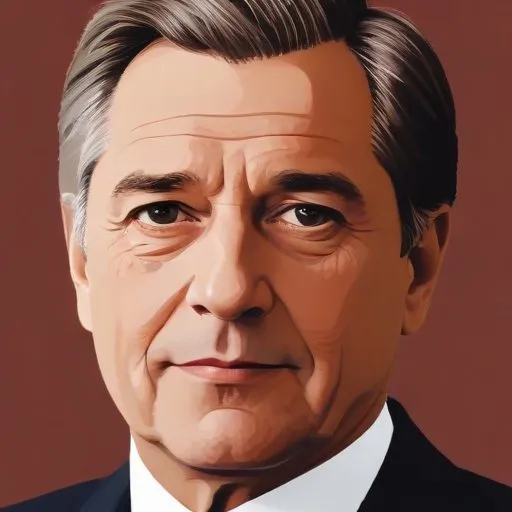
The 26th Chancellor of Austria, a lawyer and politician, served as the country's leader from 2000 to 2007, known for his conservative policies and European integration efforts. He played a key role in shaping Austria's economy and foreign policy during his tenure.
Wolfgang Schüssel, a prominent Austrian politician, is known for his two consecutive terms as Chancellor of Austria from 2000 to 2007, as well as his controversial coalition government with the Freedom Party of Austria (FPÖ) led by Jörg Haider. During his tenure, Schüssel implemented various reforms, but his governments were marred by corruption scandals and controversies.
Born on June 7, 1945, in Vienna, Austria, Schüssel attended the prestigious Schottengymnasium, a Roman Catholic gymnasium for boys, where he completed his Matura exams in 1963. He then pursued a degree in law at the University of Vienna, graduating with a doctorate in 1968.
Schüssel's political career began in 1968 as the secretary of the parliamentary group of the Austrian People's Party (ÖVP). He later became the secretary general of the Austrian Business Federation, a suborganization of the ÖVP, from 1975 to 1991. In 1989, he was appointed Minister for Economic Affairs in a coalition government under Chancellor Franz Vranitzky.
In 1995, Schüssel staged a leadership coup at the 30th Party Congress of the ÖVP, ousting Erhard Busek as chairman. He subsequently replaced the party's ministers in the governing coalition and took over as Vice-Chancellor and Minister for Foreign Affairs in Franz Vranitzky's fourth government.
Schüssel's first term as Chancellor began in 2000, during which he formed a coalition government with the FPÖ led by Jörg Haider. This move was met with widespread criticism and protests across Europe, due to Haider's far-right views and the FPÖ's history of xenophobic rhetoric. Despite this, Schüssel's government implemented several reforms, including a comprehensive tax reform and a pension reform.
Schüssel's governments were plagued by corruption scandals, with several high-ranking officials accused of bribery and embezzlement. In 2011, he retired from active politics due to the mounting allegations. Despite his controversial legacy, Schüssel is credited with modernizing Austria's economy and promoting European integration.
Schüssel is married to Christine Schüssel, and they have two children together. In addition to his political career, Schüssel has been a strong advocate for European integration and has received several honorary doctorates from European universities.
Schüssel's legacy continues to shape Austrian politics, with his reforms and policies still influencing the country's economy and society. Despite the controversies surrounding his governments, Schüssel remains a significant figure in Austrian politics, with many regarding him as a rare example of an active reformer in contemporary Austrian politics.
71 Years Old
The first female Chancellor of Germany, serving for 16 years, known for her leadership during the European sovereign-debt crisis and her role in shaping the European Union's policy. She's a highly influential figure in modern politics.
87 Years Old
The 11th President of Austria, a renowned academic and politician, served as the country's head of state from 2004 to 2016, known for promoting unity and stability. He's also a respected historian and law expert.
76 Years Old
Austrian far-right politician who served as Governor of Carinthia and was known for his controversial views on immigration and nationalism. He was a prominent figure in Austrian politics in the 1990s and early 2000s.
Born in 1918
An Austrian colonel and politician who served as the 9th President of Austria, known for his controversial past as a Nazi officer during World War II. He was also the Secretary-General of the United Nations from 1972 to 1981.
Born in 1911
The 22nd Chancellor of Austria, a prominent figure in post-WWII Austrian politics, known for his social democratic policies and efforts to maintain Austria's neutrality during the Cold War.
84 Years Old
A German-Austrian lawyer and politician who served as the President of the National Council of Austria from 2000 to 2002 and was a key figure in Austrian politics. He's known for his conservative views and leadership roles in Austrian government.
