


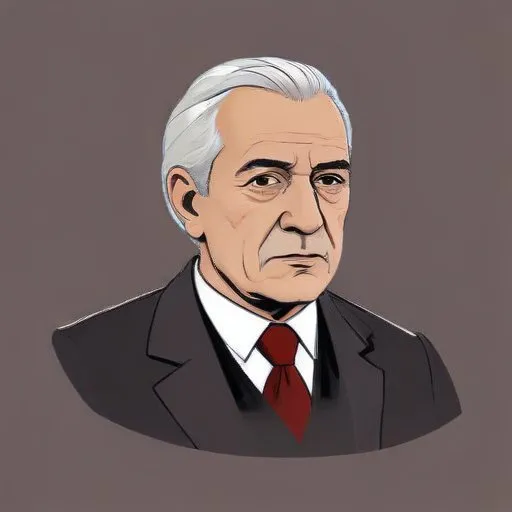
Austrian far-right politician who served as Governor of Carinthia and was known for his controversial views on immigration and nationalism. He was a prominent figure in Austrian politics in the 1990s and early 2000s.
Jörg Haider was a prominent Austrian politician known for his charismatic leadership and divisive views, which propelled him to the forefront of Austria's political landscape. As the leader of the Freedom Party of Austria (FPÖ) and later the Alliance for the Future of Austria (BZÖ), Haider left an indelible mark on Austrian politics, sparking both admiration and outrage.
Born on January 26, 1950, in Bad Goisern, Austria, Haider was the son of Robert Haider, a shoemaker, and Dorothea Rupp, a physician's daughter. His parents' early membership in the Austrian Nazi Party (DNSAP) and his father's subsequent involvement in the Nazi regime during World War II would later cast a shadow over Haider's political career.
Haider's political ascendance began in the 1980s, as he gradually rose through the ranks of the FPÖ. His youthful energy, charm, and oratory skills quickly won over party members, and he became the party's leader in 1986. Haider's populist rhetoric, which often blurred the lines between right-wing and far-right ideologies, resonated with many Austrians disillusioned with the country's traditional political elite.
Haider's tenure as Governor of Carinthia (1989-1991 and 1999-2008) was marked by controversy, as he implemented policies perceived as xenophobic and anti-immigrant. His party's coalition with the Austrian People's Party (ÖVP) in 2000 sparked international outcry, with several countries imposing diplomatic sanctions. Haider's provocative statements, including praise for Nazi-era policies and denials of Holocaust atrocities, further fueled criticism.
In 2005, Haider formed the Alliance for the Future of Austria (BZÖ), a breakaway party from the FPÖ. The move was seen as an attempt to distance himself from the far-right faction of the FPÖ. Haider led the BZÖ in the 2008 Austrian parliamentary elections, but his life was cut short in a car accident on October 11, 2008, at the age of 58.
Haider's legacy remains complex and contested. While he mobilized a significant following among Austrians disillusioned with the political establishment, his controversial views and actions sparked widespread criticism and international condemnation. Despite his flaws, Haider's impact on Austrian politics cannot be denied, as he pushed the boundaries of acceptable political discourse and challenged the country's traditional power structures.
"The Austrian people are tired of being ruled by the old parties and their corrupt elites. We want to create a new Austria, a Austria of the people, by the people, and for the people."
Haider's provocative statements and quotes often sparked outrage, but they also reflected his ability to tap into the frustrations and anxieties of many Austrians.
57 Years Old
Austrian politician who served as Vice Chancellor of Austria and leader of the Freedom Party, known for his far-right and nationalist views. He resigned amid a corruption scandal in 2019.
82 Years Old
The current President of Austria, a former economics professor and Green Party leader, known for his strong stance on environmental issues and European integration.
Born in 1918
An Austrian colonel and politician who served as the 9th President of Austria, known for his controversial past as a Nazi officer during World War II. He was also the Secretary-General of the United Nations from 1972 to 1981.
Born in 1911
The 22nd Chancellor of Austria, a prominent figure in post-WWII Austrian politics, known for his social democratic policies and efforts to maintain Austria's neutrality during the Cold War.
66 Years Old
The 28th Chancellor of Austria, serving from 2008 to 2016, is most known for his strong stance on European Union policies and his efforts to reform Austria's economy. He played a key role in shaping the country's response to the European sovereign-debt crisis.
