


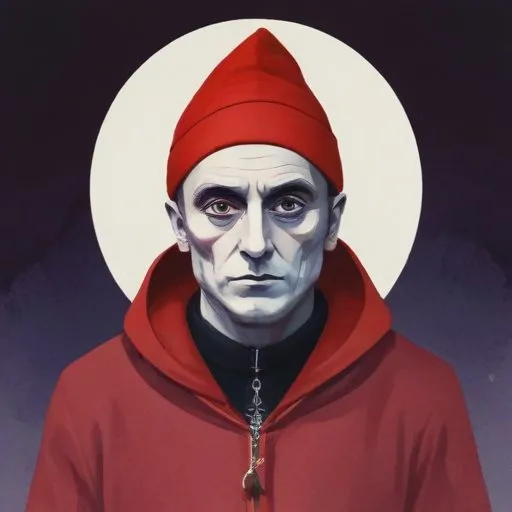
A French occultist who developed the concept of Synarchy, a form of government where spiritual and temporal powers are combined, and wrote influential works on mysticism and the occult.
Alexandre SaintYves d'Alveydre, a French occultist, is renowned for adapting the works of Fabre d'Olivet and developing the concept of Synarchy, a political philosophy that envisions a harmonious association of everyone with everyone else. His groundbreaking ideas have had a profound impact on politics and the occult, influencing prominent figures like René Guénon and Papus.
Born on March 26, 1842, in Paris, SaintYves d'Alveydre was raised in a family of intellectuals and was the son of psychiatrist Guillaume-Alexandre SaintYves. He began his career as a physician at a naval academy in Brest but soon abandoned it due to illness. In 1863, he relocated to Jersey, where he formed a connection with the celebrated writer Victor Hugo.
In 1870, SaintYves returned to France to participate in the Franco-Prussian War, during which he was injured. After the war, he embarked on a career as a civil servant. In 1877, he married Countess Marie de Riznitch-Keller, a relative of Honoré de Balzac and friend of Empress Eugénie de Montijo. This union made him independently wealthy and allowed him to dedicate his life to research.
SaintYves d'Alveydre was a member of several Rosicrucian and Freemason-style orders and befriended prominent figures in French occultism, including Marquis Stanislas de Guaita, Joséphin Péladan, and Oswald Wirth. He claimed to have inherited the papers of Antoine Fabre d'Olivet, a founder of French occultism.
In 1877, SaintYves published two notable works: The Lyrical Testament, a collection of poetry, and Keys of the Orient, a book that presented a solution to the "Question of the Orient" – the tensions in the Near and Middle East caused by the decay of the Ottoman Empire. His solution was based on developing a religious understanding between Jews, Christians, and Muslims.
SaintYves d'Alveydre's most significant contribution is the development of Synarchy, a concept that advocates for the association of everyone with everyone else. He envisioned a harmonious, hierarchical system where each individual would fulfill their role in the collective, leading to a more balanced and just society.
SaintYves d'Alveydre's ideas about Synarchy have influenced politics and the occult, shaping the thoughts of prominent figures like René Guénon and Papus. His work has also inspired modern spiritual and esoteric movements, making him a pioneer in the realm of occultism.
Alexandre SaintYves d'Alveydre's life and work are a testament to his dedication to exploring the mysteries of the universe. His unique blend of occultism, spirituality, and politics has left an indelible mark on modern esoteric thought. As we navigate the complexities of our globalized world, SaintYves d'Alveydre's vision of Synarchy serves as a beacon, guiding us toward a more harmonious and balanced future.
Born in 1861
A French poet and author who delved into the mysteries of occultism and esotericism, producing influential works on mysticism and the Kabbalah. His writings continue to inspire modern spiritual seekers.
Born in 1886
A French-Egyptian philosopher and author who wrote extensively on spirituality, metaphysics, and traditionalism, critiquing modern Western society and advocating for a return to spiritual and intellectual traditions.
Born in 1875
A renowned occultist and mystic who wrote extensively on magic, mysticism, and thelema, and is often associated with the phrase "Do what thou wilt shall be the whole of the Law."
