


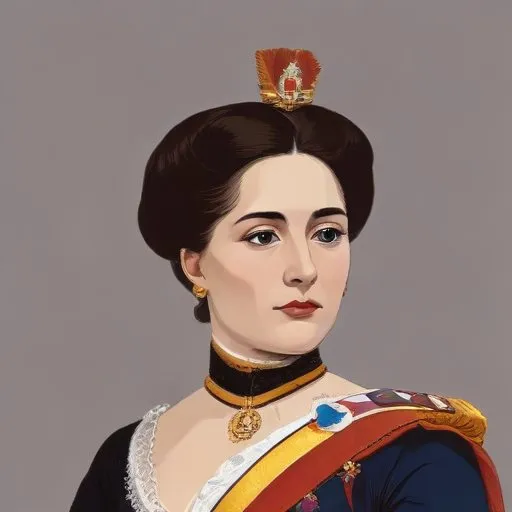
The last Empress of France, known for her fashion sense and lavish lifestyle, which influenced European aristocracy and high society. She was a patron of the arts and a trendsetter in her time.
Eugénie de Montijo, the 19th Countess of Teba and 16th Marquise of Ardales, was the Empress of the French from her marriage to Napoleon III on 30 January 1853 until the Emperor was overthrown on 4 September 1870. As the last Empress of the French Second Empire, she left an indelible mark on French history, shaping the nation's politics, culture, and identity.
Born on 5 May 1826 in Granada, Spain, Eugénie was the youngest child of Don Cipriano de Palafox y Portocarrero and María Manuela Enriqueta Kirkpatrick y Grivegne. Her father's numerous titles, including the 13th Duke of Peñaranda de Duero and 8th Count of Ablitas, solidified her position as a member of the Spanish nobility. Eugénie's early life was marked by a strict education in France, Spain, and England, emphasizing languages, literature, and music.
In 1853, Eugénie married Napoleon III, who had been enthralled by her beauty and intelligence. The marriage was a strategic alliance between the French and Spanish monarchies, solidifying Napoleon's claim to the throne. As Empress, Eugénie used her influence to champion authoritarian and clerical policies, earning her both admiration and criticism from contemporaries. Her involvement in politics was unprecedented for a woman of her time, and she played a significant role in shaping Napoleon's decisions.
Eugénie and Napoleon had one son, Louis-Napoléon, Prince Imperial, born in 1856. Tragedy struck when Napoleon III was overthrown in 1870, and the family was exiled to England. Eugénie's life was marked by grief when her husband died in 1873, followed by her son's untimely death in 1879. The loss of her loved ones only strengthened her resolve to commemorate their memories and the legacy of the Second Empire.
In exile, Eugénie dedicated herself to preserving the memory of her husband and son. She built the Imperial Mausoleum in Farnborough, Hampshire, as a final resting place for her family. The Empress also established the Napoleon III Museum in Hartwell House, Aylesbury, showcasing her husband's collections and personal artifacts. Her efforts ensured that the Second Empire's legacy endured, even in the face of adversity.
Eugénie de Montijo's influence extended far beyond her role as Empress. She was a patron of the arts, supporting renowned artists and writers, including Charles Garnier, who designed the Paris Opera House. Her commitment to education led to the establishment of several schools and institutions, including the Imperial Normal School for Young Ladies. Eugénie's philanthropic work also extended to charitable organizations, such as the French Red Cross.
As a woman who defied convention, Eugénie de Montijo left an indelible mark on French history. Her unwavering dedication to her family, her country, and her legacy serves as a testament to her strength and character. The Empress of the French may have lived in a bygone era, but her impact continues to resonate in the modern world.
"I am not a woman, I am the Empress."
Born in 1811
The son of Napoleon Bonaparte, he was the titular Emperor of the French from 1811 to 1832, although he never actually ruled. He's known for his brief, tumultuous life and mysterious death.
Born in 1819
The monarch who ruled the British Empire for 63 years, overseeing the Industrial Revolution and expanding the empire's reach, earning the nickname "the Grandmother of Europe".
Born in 1815
Unified Germany's founder, a master strategist who forged a nation through diplomacy and war, leaving a lasting legacy in European politics.
