


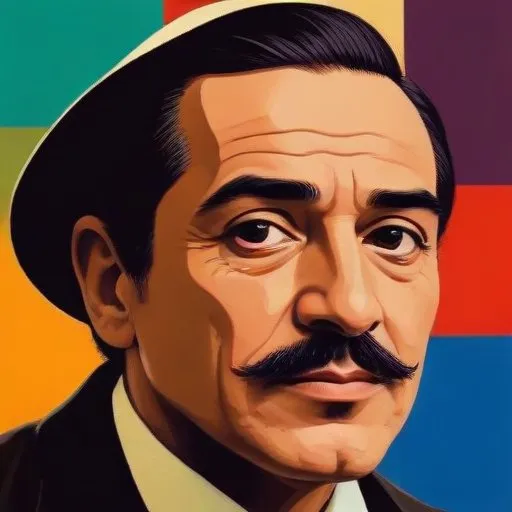
A leading figure in Mexican literature, known for his poetry, essays, and literary criticism that explored the intersection of Mexican identity and European culture.
Alfonso Reyes, a Mexican writer, philosopher, and diplomat, is renowned for his profound contributions to Spanish-language literature, earning him five Nobel Prize nominations. His literary creations have been hailed as masterpieces, solidifying his position as one of the greatest authors in the Spanish language.
Born on May 17, 1889, in Monterrey, Nuevo León, Mexico, Reyes was the ninth of twelve children to General Bernardo Reyes Ogazón, Governor of the State of Nuevo León and Secretary of War and Navy of President Porfirio Díaz. His mother, Aurelia Ochoa Garibay y Sapín, was a member of a prominent family of Jalisco, direct descendants of Conquistador Diego de Ochoa Garibay.
Reyes received his education at various colleges in Monterrey, El Liceo Francés de México, and El Colegio Civil de Monterrey. He later attended the Escuela Nacional Preparatoria and graduated from the La Escuela Nacional de Jurisprudencia in 1913, which later became the law school at UNAM.
In 1909, Reyes co-founded the Ateneo de la Juventud, a group of young intellectuals dedicated to promoting new cultural and aesthetic ideals and educational reform in Mexico. This intellectual circle included notable figures such as Martín Luis Guzmán, José Vasconcelos, Julio Torri, and Pedro Henríquez Ureña.
Reyes published his first book, Cuestiones estéticas, in 1911, followed by the short story La Cena (The Supper) in 1912. This short story is considered a precursor to surrealism and Latin American magical realism. In the same year, he became the Secretary of the Escuela Nacional de Altos Estudios at the National Autonomous University of Mexico.
Reyes was posted to Mexico's diplomatic service in France in 1913. After Germany invaded France in 1914, he moved to Madrid, Spain, where he continued to pursue his literary career. He later served as ambassador of Mexico to Argentina and Brazil.
Throughout his life, Reyes was recognized for his literary achievements, earning him numerous nominations for the Nobel Prize in Literature. His work has had a profound impact on Spanish-language literature, solidifying his position as one of the greatest authors of his time.
Reyes' philosophical contributions focused on promoting cultural and aesthetic ideals, as well as educational reform in Mexico. He believed in the importance of intellectual curiosity and the pursuit of knowledge, which is reflected in his literary works.
Alfonso Reyes' literary contributions and diplomatic career have had a lasting impact on Mexican culture and Spanish-language literature. His work continues to inspire new generations of writers, philosophers, and intellectuals.
Through his writings, Reyes promoted cultural and aesthetic ideals, educational reform, and intellectual curiosity, leaving a profound legacy in the world of literature and philosophy.
Born in 1914
A Mexican poet and diplomat who won the Nobel Prize in Literature in 1990 for his work that explores the intersection of poetry, philosophy, and politics. He's known for his lyrical and introspective style that explores the human condition.
97 Years Old
A renowned Mexican writer, celebrated for his novels and essays that explored the complexities of Mexican identity, politics, and culture. His works often blended mythology, history, and fantasy to create a unique narrative style.
Born in 1917
A pioneering writer and photographer who blended magical realism with stark social commentary, capturing the essence of rural Mexico through his poignant and evocative works.
Born in 1899
A visionary writer who crafted intricate, philosophical tales that blurred reality and fantasy, influencing generations of authors and thinkers. 82
Born in 1904
A Chilean poet and diplomat who wrote passionate and evocative poetry that explored love, politics, and the human condition, and was awarded the Nobel Prize in Literature in 1971.
99 Years Old
A Colombian journalist and author who crafted magical realism, a literary style that blends fantasy and reality, and won the Nobel Prize in Literature in 1982. His works are known for their vivid storytelling and exploration of human experience.
Born in 1914
A pioneering figure in magical realism, blending fantastical elements with everyday life in his novels and short stories, exploring the human condition and social commentary.
90 Years Old
A Nobel Prize-winning writer and politician who explored the complexities of Peruvian society through his novels and essays, and later ran for president. His works often blended politics, history, and fiction.
