


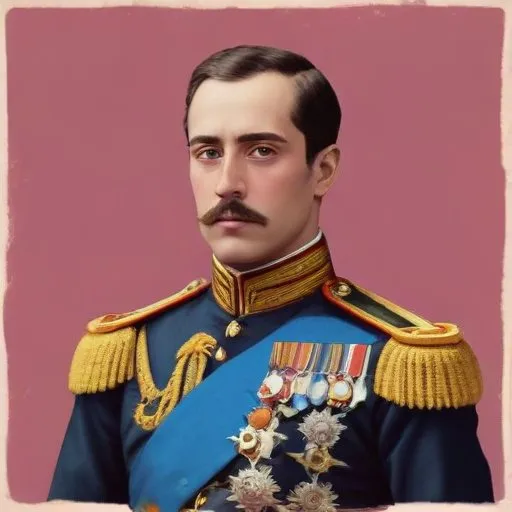
Restored the Bourbon dynasty to the Spanish throne after a brief republican period, modernizing and stabilizing the country. Known for his efforts to reform and strengthen Spain's economy and military.
Alfonso XII of Spain is known for being the king who brought an end to the tumultuous First Republic of Spain and restored the monarchy, leading his country towards a period of relative peace and prosperity. Born on November 28, 1857, he ruled Spain from 1874 to 1885, leaving a lasting legacy that continues to be felt today.
Alfonso was the son of Queen Isabella II and King Francisco de Asís, Duke of Cádiz. He spent his early years in exile, following his mother's abdication in 1868. During this time, he received a thorough education, studying in Vienna, Austria, and later in England. In 1870, he was proclaimed king by the Spanish Cortes Generales, marking the beginning of the Bourbon Restoration.
Alfonso XII's reign was marked by significant reforms and modernizations. He focused on strengthening the Spanish economy, promoting foreign investment, and developing infrastructure projects such as the construction of railways and telegraph lines. He also introduced the peseta as the new Spanish currency, replacing the peso.
The king's commitment to a constitutional monarchy led to the establishment of the Spanish Constitution of 1876, which limited the monarch's power and established the principles of universal suffrage and freedom of assembly. This move helped to stabilize the country and paved the way for a more democratic Spain.
In 1878, Alfonso XII married Mercedes of Orléans, daughter of the Duke of Orléans. Although their marriage was short-lived, it produced two daughters, María de las Mercedes and María Cristina. Following Mercedes' death, the king married Archduchess Maria Christina of Austria, with whom he had three more children.
Alfonso XII's untimely death on November 25, 1885, at the age of 27, was a shock to the nation. Despite his short reign, he had managed to bring stability and progress to Spain. His legacy continued to shape the country's development, and he is remembered as the "Pacificador" (Pacificador) for his role in bringing peace to Spain.
Alfonso XII's reign took place during a tumultuous period in European history, marked by the Franco-Prussian War and the rise of nationalism. His commitment to a constitutional monarchy and his reforms helped to establish Spain as a modern, European nation. Today, he is remembered as a key figure in Spanish history, and his legacy continues to inspire Spaniards around the world.
Alfonso XII's reign was marked by a distinct approach to monarchy, one that prioritized constitutionalism and modernization. In contrast to his contemporaries, such as King Umberto I of Italy, who struggled with reunification and nationalism, Alfonso XII's focus on stability and progress helped to establish Spain as a beacon of stability in Europe.
Alfonso XII's life and legacy serve as a testament to the power of forward-thinking leadership and the importance of stability in times of turmoil. His impact on Spanish history is undeniable, and his story continues to inspire and fascinate people around the world.
Born in 1886
The last Bourbon king of Spain, ruling from 1886 to 1931, known for his tumultuous reign marked by political instability, economic struggles, and the loss of Spain's last colonies.
Born in 1887
The last queen of Spain before the abolition of the monarchy, she was a British princess who married King Alfonso XIII and played a significant role in Spanish history.
Born in 1892
The authoritarian leader who ruled Spain with an iron fist from 1939 to 1975, suppressing opposition and imposing conservative values, while also modernizing the economy. He's infamous for his brutal regime and human rights abuses.
88 Years Old
The former King of Spain who reigned from 1975 to 2014, known for transitioning the country from dictatorship to democracy and playing a key role in preventing a military coup in 1981.
58 Years Old
The current King of Spain, reigning since 2014, known for his efforts to modernize the monarchy and promote Spanish culture. He's also been involved in various charitable initiatives and international diplomacy.
