


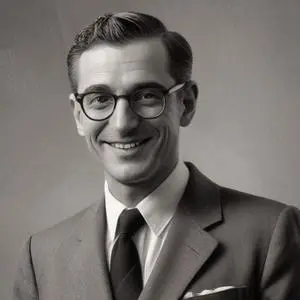
A pioneering photojournalist capturing intimate, revealing moments of the famous and ordinary, particularly iconic portraits of celebrities and world leaders.
Alfred Eisenstaedt, the renowned German-born American photographer, is best known for his iconic images that have become synonymous with some of the most pivotal moments in history. With over 90 of his photographs gracing the covers of Life magazine, Eisenstaedt's work not only captured the essence of the human experience but also shaped the way we remember historical events.
Born on December 6, 1898, in Dirschau, West Prussia, Imperial Germany, Eisenstaedt's fascination with photography began at the tender age of 11, when he received his first camera, an Eastman Kodak Folding Camera with roll film. This early introduction sparked a lifelong passion that would take him on an extraordinary journey.
After serving in the German Army's artillery during World War I, Eisenstaedt worked as a belt and button salesman in the 1920s in Weimar Germany. During this time, he began taking photographs as a freelancer for the Pacific and Atlantic Photos Berlin office, which was later taken over by the Associated Press in 1931.
In 1929, Eisenstaedt became a full-time photographer, working for the Associated Press office in Germany. Within a year, he was hailed as a "photographer extraordinaire." His work with Illustrierte Zeitung, published by Ullstein Verlag, then the world's largest publishing house, further solidified his reputation as a master of his craft.
One of Eisenstaedt's most famous photographs, "V-J Day in Times Square," taken on August 14, 1945, encapsulates the euphoria of Americans celebrating the end of World War II. The image, featuring an American sailor kissing a nurse in a dance-like dip, has become an enduring symbol of that momentous day.
Other notable works include his photograph of the historic meeting between Adolf Hitler and Benito Mussolini in Italy, as well as his candid shots of world leaders, celebrities, and everyday people, all captured with his trusty 35mm Leica camera and natural lighting.
Eisenstaedt's contributions to photography were recognized with numerous awards, including the National Medal of Arts, the Presidential Medal of Freedom, and three Pulitzer Prize nominations. He was also inducted into the International Photography Hall of Fame and the American Society of Media Photographers' Hall of Fame.
Today, Eisenstaedt's photographs continue to inspire generations of photographers, journalists, and historians. His legacy serves as a testament to the power of photography to capture the essence of the human experience and to shape our collective memory.
Eisenstaedt's personal life was marked by significant milestones, including his emigration to the United States in 1935, where he became a naturalized citizen in 1944. He married his wife, Ruth, in 1951, and the couple remained together until his passing on August 23, 1995, at the age of 96.
Throughout his life, Eisenstaedt remained humble and dedicated to his craft, once saying, "I don't take pictures, pictures take me." This philosophy guided his approach to photography, resulting in a body of work that continues to captivate and inspire us today.
Born in 1908
A pioneer of street photography, capturing life's fleeting moments in elegant, geometric compositions that defined the genre. Known for coining the term "the decisive moment."
Born in 1923
A visionary photographer who captured iconic portraits of celebrities, politicians, and everyday people, revealing the human spirit through his lens.
Born in 1902
Pioneering landscape photographer and conservationist capturing iconic black-and-white images of the American West, advocating for environmental protection through art.
Born in 1895
Documented the lives of those affected by the Great Depression and the Dust Bowl through powerful, poignant photographs that humanized the struggles of the era. Captured iconic images that shaped the national conversation around poverty and social justice.
Born in 1904
Pioneering photographer and journalist who captured iconic images of the Great Depression and World War II, and was the first woman to fly on a combat mission.
Born in 1912
A pioneering African American photographer and filmmaker who captured the lives of marginalized communities, exposing social injustices through powerful, poignant images.
Born in 1923
A pioneering photographer who captured intimate, often unsettling portraits of marginalized individuals, revealing the beauty in the unconventional and challenging societal norms.
98 Years Old
A pioneer of street photography, capturing candid, unposed moments of everyday life in post-war America, revealing the beauty in the mundane.
