


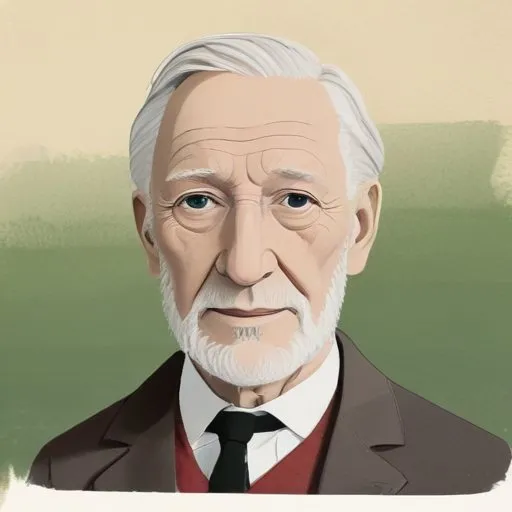
Alfred Wallis, a British fisherman-turned-artist, is renowned for his captivating port landscapes and shipping scenes, painted in a distinctive naïve style. With no formal artistic training, Wallis began painting at the age of 70, using household paint on scraps of cardboard, and yet, his work continues to fascinate art enthusiasts to this day.
Born on August 18, 1855, in Devonport, Devon, Wallis was the son of Charles and Jane Wallis, who later moved back to Penzance, Cornwall, after his mother's death. After leaving school, Wallis was apprenticed to a basketmaker and later became a mariner in the merchant service, sailing across the North Atlantic between Penzance and Newfoundland.
Wallis's life took a dramatic turn after the death of his wife, Susan Ward, in 1922. To cope with the loneliness, he took up painting, driven by a desire for companionship. Self-taught and with no formal artistic training, Wallis's paintings were a reflection of his experiences as a mariner, showcasing his unique perspective and style.
Wallis's paintings are characterized by their naïve style, where perspective is ignored, and an object's scale is often determined by its relative importance in the scene. This distinctive approach gives his paintings a unique, almost childlike quality, which has captivated art lovers and critics alike.
Wallis's work was championed by progressive artists, including Ben Nicholson and Christopher Wood, who recognized the significance of his unique style. Despite achieving little commercial success during his lifetime, Wallis's work has continued to inspire generations of artists and art enthusiasts.
Alfred Wallis's contribution to the world of art is a testament to the power of creativity and innovation. His paintings have inspired a new wave of naïve artists, and his story serves as a reminder that it's never too late to pursue one's passion. Today, Wallis's work is recognized as an important part of British art history, and his legacy continues to grow.
"I paint because I like to, and I'll go on painting until I die." - Alfred Wallis
Alfred Wallis's remarkable story serves as a testament to the power of creativity and determination. His paintings continue to inspire and delight, and his legacy will live on as a beacon of hope for those who dare to pursue their passions, no matter the age or circumstance.
Born in 1894
A pioneer of abstract art, he's renowned for his geometric, minimalist paintings and sculptures that blend simplicity with profound emotional depth.
91 Years Old
A British novelist and screenwriter, best known for co-authoring the James Bond novel "James Bond, The Spy Who Loved Me" and writing several episodes of the popular TV series "The Avengers".
Born in 1860
A British artist known for his impressionist and avant-garde paintings, particularly his depictions of urban landscapes and music hall scenes. His work often explored the intersection of art and psychology.
Born in 1889
A surrealist painter who blended landscapes with abstract forms, creating dreamlike scenes that explored the relationship between nature and the human psyche.
Born in 1879
This celebrated author crafted novels and plays that probed the human condition, exploring themes of social class, morality, and personal relationships, with a distinctive wit and insight. Their works continue to captivate audiences with their nuanced portrayals of English society during the early 20th century.
Born in 1885
A pioneering writer of the early 20th century, known for exploring themes of human nature, relationships, and the clash between individual desire and societal expectations through novels like "Sons and Lovers" and "Lady Chatterley's Lover".
Born in 1882
A pioneering author of modernist literature, known for experimental novels and essays that explored the human experience, blurring the lines between reality and fiction.
Born in 1880
A leading figure in the Bloomsbury Group, known for revolutionizing biography writing with witty, irreverent, and psychologically nuanced portraits of historical figures.
