


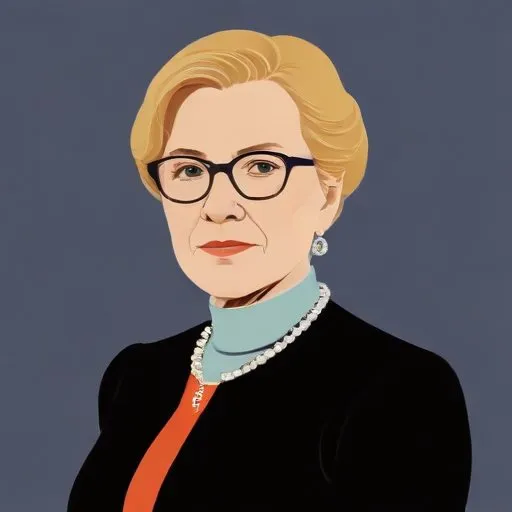
A Swedish sociologist and politician who pioneered disarmament and women's rights, earning a Nobel Peace Prize in 1982 for her efforts to reduce nuclear proliferation.
Alva Myrdal, a Swedish sociologist, diplomat, and politician, is renowned for her tireless efforts to promote disarmament and social justice, earning her the Nobel Peace Prize in 1982. Alongside Alfonso García Robles, she was recognized for her work as a prominent leader of the disarmament movement, bringing attention to the devastating consequences of nuclear proliferation.
Born on January 31, 1902, in Uppsala, Sweden, Alva Myrdal grew up in a modest family with four siblings. Her father, Albert Reimer, was a socialist and modern liberal who instilled in her a strong sense of social responsibility. Myrdal's academic pursuits took her to Stockholm, where she earned a Bachelor of Science degree in psychology and family sociology in 1924.
In 1929, Myrdal and her husband, Gunnar Myrdal, traveled to the United States as Rockefeller Fellows. During their time in the US, Myrdal deepened her studies in psychology, education, and sociology, gaining valuable insights into children's education. Her experiences in the US, marked by stark social and economic disparities, further radicalized her political views, leading her to adopt a self-described "radical" outlook.
Myrdal's work in the 1930s focused on population decline, a pressing concern in interwar Europe. Her research, conducted alongside her husband, led to the publication of several influential works, including "Crisis in the Population Question" (1934). This period marked the beginning of her public prominence, as she became an authority on family and population issues.
In the 1940s, Myrdal's diplomatic career took off, with appointments to the Swedish Ministry of Education and the United Nations. Her tireless advocacy for disarmament and international cooperation culminated in the Nobel Peace Prize in 1982. This honor, shared with Alfonso García Robles, solidified her position as a leading voice in the global disarmament movement.
Alva Myrdal's marriage to Gunnar Myrdal, a Nobel laureate in Economic Sciences (1974), made them the fourth married couple to win Nobel Prizes. Their partnership was marked by a shared commitment to social justice and a passion for intellectual pursuits. Throughout her life, Myrdal remained dedicated to promoting peace, disarmament, and social justice, leaving behind a rich legacy that continues to inspire generations of scholars and activists.
"Disarmament is not a utopian dream, but a realistic necessity."
Alva Myrdal's courageous efforts to challenge the status quo and promote a more just and peaceful world continue to resonate with us today. As we reflect on her remarkable life and achievements, we are reminded of the power of individual action and the importance of striving for a world free from the threat of nuclear proliferation.
Born in 1905
A Swedish economist and diplomat who served as the 2nd Secretary-General of the United Nations, promoting international cooperation and peace, and posthumously awarded the Nobel Peace Prize. He's known for his tireless efforts to resolve global conflicts and promote humanitarian causes.
Born in 1908
Developed the theory of magnetohydrodynamics, which explains the behavior of plasmas, and was a pioneer in the field of space physics, making significant contributions to our understanding of the Earth's magnetic field and the solar wind.
Born in 1895
Developed econometrics, a statistical approach to economic analysis, and founded the discipline of econophysics, earning the first Nobel Prize in Economics in 1969.
Born in 1899
A Swedish economist and politician who won the Nobel Prize for developing the Heckscher-Ohlin model, which explains international trade and economic growth.
Born in 1860
A Swedish journalist and politician who served as Prime Minister of Sweden and was awarded the Nobel Peace Prize for his efforts to promote international cooperation and peace. He played a key role in establishing the League of Nations.
Born in 1901
A Swedish politician who served as Prime Minister from 1946 to 1969, leading the country through a period of significant social and economic reform. He's known for his progressive policies and strong leadership.
99 Years Old
A Swedish statesman who served as Prime Minister of Sweden from 1969 to 1976 and 1982 to 1986, known for his progressive policies and international diplomacy. Assassinated in 1986, his murder remains unsolved.
