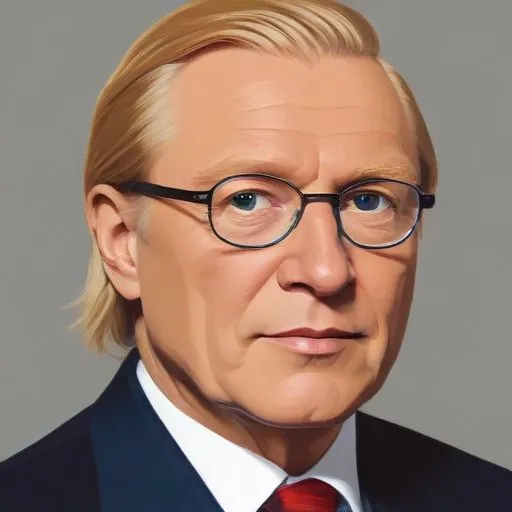
Bertil Ohlin: The Architect of Modern International Trade Theory
A Legacy of Pathbreaking Contributions
Bertil Ohlin, a Swedish economist and politician, is renowned for his pioneering work in the field of international trade and international capital movements, which earned him the Nobel Memorial Prize in Economic Sciences in 1977. His collaborative efforts with Eli Heckscher led to the development of the Heckscher-Ohlin model, a cornerstone of modern international trade theory.
Early Life and Education
Born on April 23, 1899, in Klippan, Scania, Sweden, Ohlin was raised in a family of seven siblings. His mother's left-liberal views and the influence of Nordic partnership and
Karl Staaff shaped his perspective on society. Ohlin's academic pursuits began at Lund University, where he earned his B.A. at the age of 18. He went on to obtain his MSc. from the Stockholm School of Economics in 1919, followed by an M.A. from Harvard University in 1923, and finally, his doctorate from Stockholm University in 1924 at the age of 25.
Academic and Political Career
Ohlin's academic career took off in 1925, when he became a professor at the University of Copenhagen. Four years later, he returned to Sweden to assume a professorship at the Stockholm School of Economics, a position he held until 1965. Ohlin's academic pursuits were complemented by his venture into politics, where he served as the leader of the People's Party, a social-liberal party, from 1944 to 1967. During World War II, he briefly held the position of Minister of Commerce and Industry in the Swedish coalition government from 1944 to 1945. Ohlin also presided over the Nordic Council in 1959 and 1964.
The Heckscher-Ohlin Model
The Heckscher-Ohlin model, developed in collaboration with Eli Heckscher, is a seminal contribution to the theory of international trade. This model posits that countries will export goods that utilize their abundant factors of production and import goods that require scarce factors. This concept has had a profound impact on our understanding of international trade and has far-reaching implications for economic policy.
Nobel Memorial Prize and Recognition
Ohlin's work on international trade and capital movements earned him the Nobel Memorial Prize in Economic Sciences in 1977, which he shared with British economist
James Meade. This recognition cemented his status as a leading figure in the field of economics.
Influence on Modern Society
Ohlin's contributions have had a lasting impact on modern society. His work on international trade has informed economic policy and shaped the global economy. His legacy continues to influence economic theory and practice, making him a household name in the world of economics.
Personal Milestones and Key Life Events
- 1917: Earned B.A. from Lund University at the age of 18
- 1919: Obtained MSc. from Stockholm School of Economics
- 1923: Earned M.A. from Harvard University
- 1924: Awarded doctorate from Stockholm University at the age of 25
- 1925: Became a professor at the University of Copenhagen
- 1929: Debated with John Maynard Keynes on the consequences of war reparations
- 1944: Became leader of the People's Party and Minister of Commerce and Industry
- 1959 and 1964: Presided over the Nordic Council
- 1965: Retired from professorship at Stockholm School of Economics
- 1977: Awarded Nobel Memorial Prize in Economic Sciences
Legacy and Historical Context
Ohlin's life and work are a testament to his commitment to advancing economic theory and practice. His legacy continues to shape our understanding of international trade and informs economic policy to this day. As a scholar, politician, and Nobel laureate, Ohlin's impact on modern society is undeniable.
FAQ
What contributions did Bertil Ohlin make to international trade?
Bertil Ohlins work on international trade led to the development of the Heckscher-Ohlin model, which explains how countries trade goods and services based on differences in factor endowments. This model has had a significant impact on our understanding of international trade and has influenced trade policies worldwide.
What is Bertil Ohlins Nobel Prize in Economics for?
Bertil Ohlin was awarded the Nobel Prize in Economics in 1977 for his work on international trade and economic integration. His work, along with that of James Meade, provided a framework for analyzing the effects of trade policies on economic welfare.
What was Bertil Ohlins role in Swedish politics?
Bertil Ohlin was a prominent figure in Swedish politics, serving as the leader of the Liberal Peoples Party from 1944 to 1967. During his tenure, he played a key role in shaping Swedens economic and social policies.
What is the Heckscher-Ohlin model used for?
The Heckscher-Ohlin model is used to explain the patterns of international trade and the effects of trade policies on economic welfare. It is also used to analyze the impact of trade on income distribution and economic growth.
What is Bertil Ohlins legacy in economics?
Bertil Ohlins work has had a lasting impact on the field of economics, particularly in the areas of international trade and economic integration. His contributions have influenced generations of economists and continue to shape trade policies today.