


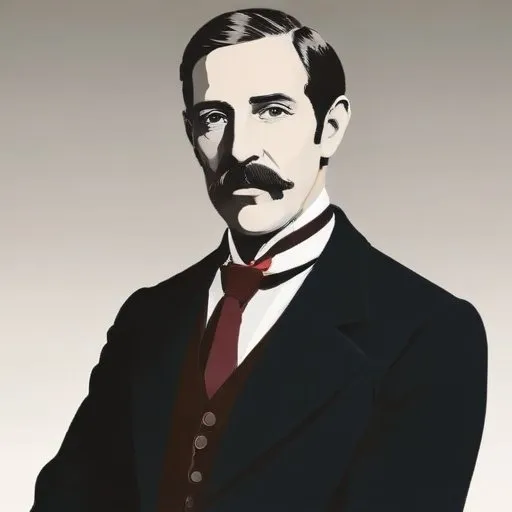
Innovative engineer and inventor who revolutionized transportation with the introduction of the first cable car system, transforming urban mobility and shaping city landscapes.
Andrew Smith Hallidie is renowned for promoting the Clay Street Hill Railroad in San Francisco, the world's first practical cable car system. This innovative transportation solution has earned him the distinction of being regarded as the inventor of the cable car and the father of the present-day San Francisco cable car system.
Born on March 16, 1836, in London, England, Andrew Smith Hallidie was the son of Julia Johnstone Smith from Lockerbie, Dumfriesshire, and Andrew Smith, a prolific inventor from Fleming, Dumfriesshire, Scotland. Hallidie's early life was marked by a strong influence from his inventive father, who held patents for the box door spring, floor cramp, and wire rope.
In 1852, Hallidie, then just 16, sailed to California with his father to explore the state's promising gold mines. When his father returned to England in 1853, Hallidie remained in California to pursue his own adventures. He worked as a gold miner, blacksmith, surveyor, and bridge builder, gaining hands-on experience that would later shape his innovative endeavors.
In 1856, while working on a construction project at American Bar, Hallidie was confronted with the rapid wear and tear of ropes used to lower cars of rock from the mine to the mill. This challenge sparked an idea. He improvised machinery to create wire rope, using his father's designs, which lasted an impressive two years. This breakthrough marked the beginning of wire rope manufacturing in California and sowed the seeds for his future cable car innovations.
Hallidie's innovative spirit and perseverance in the face of challenges reflect his strong work ethic and commitment to finding practical solutions to real-world problems. His dedication to improving transportation and infrastructure in California demonstrates his passion for enhancing the lives of others through technology and innovation.
Andrew Smith Hallidie's contributions to the development of the cable car system have had a lasting impact on San Francisco's transportation landscape. Today, the iconic cable cars are an integral part of the city's identity, attracting tourists and locals alike. His innovative spirit and perseverance continue to inspire generations of entrepreneurs, inventors, and engineers.
Hallidie's legacy is celebrated through various commemorations, including a commemorative plaque at the intersection of Clay and Kearny Streets in San Francisco, marking the site of the original Clay Street Hill Railroad.
"The greatest glory in living lies not in never falling, but in rising every time we fall." - Andrew Smith Hallidie
Hallidie's life and achievements are set against the backdrop of the California Gold Rush, a period of rapid growth and transformation in the United States. His innovations in wire rope and cable cars coincided with the expansion of San Francisco, cementing his place in the city's rich history.
Andrew Smith Hallidie passed away on April 24, 1900, leaving behind a legacy of innovation, perseverance, and progress. His remarkable story continues to inspire generations, serving as a testament to the power of human ingenuity and determination.
Born in 1806
A visionary engineer who revolutionized transportation with innovative designs, including the iconic Clifton Suspension Bridge, which transformed urban landscapes.
Born in 1781
Designed the Liverpool and Manchester Railway, a pioneering feat that revolutionized transportation and paved the way for modern rail networks.
Born in 1791
Pioneering scientist who discovered electromagnetic induction, formulated the laws of electrolysis, and invented the first electrical generator, revolutionizing our understanding of electricity and its applications.
Born in 1791
A pioneer in computer science, credited with inventing the first mechanical computer, the Difference Engine, and conceptualizing the Analytical Engine, a precursor to modern computers.
Born in 1815
Pioneering mathematician and computer scientist who wrote the first algorithm intended to be processed by a machine, and is often considered the first computer programmer. Her work on Charles Babbage's Analytical Engine envisioned its potential to go beyond mere calculation and perform any task that could be expressed in a series of steps.
Born in 1856
A pioneering engineer who harnessed the power of alternating current (AC) to transform the world's electrical systems, and is credited with developing groundbreaking technologies like radio communication and X-ray imaging.
Born in 1847
A pioneer in innovation, credited with developing groundbreaking inventions that revolutionized the way people live and communicate, including the light bulb and phonograph.
Born in 1853
Developed groundbreaking inventions and innovations in electrical engineering, including the first practical welding machine and the first electric streetcar system.
