


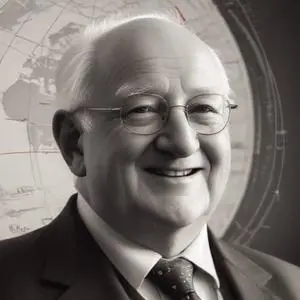
A renowned economist and academic, he is most known for his groundbreaking work on poverty, inequality, and economic development, which has significantly influenced global economic policies. His research has shed light on the complexities of human well-being and the consequences of economic growth.
Angus Deaton, a British-American economist, is renowned for his groundbreaking research on poverty, inequality, health, wellbeing, and economic development. His pioneering work in the field of economics earned him the Nobel Memorial Prize in Economic Sciences in 2015, solidifying his position as a leading authority in the field.
Deaton was born on October 19, 1945, in Edinburgh, Scotland. He attended Hawick High School and later Fettes College as a foundation scholar. During his summer break in 1964, he worked at Portmeirion hotel, an experience that would shape his perspective on the importance of economic development.
Deaton earned his B.A., M.A., and Ph.D. degrees at the University of Cambridge. His Ph.D. thesis, titled "Models of Consumer Demand and Their Application to the United Kingdom," was completed under the supervision of Richard Stone in 1975. This research laid the foundation for his future work on consumer demand and its impact on poverty and welfare.
In 1978, Deaton became the first ever recipient of the Frisch Medal, an honor bestowed by the Econometric Society every two years for outstanding applied research. This recognition catapulted him into the spotlight, and his subsequent research continued to push the boundaries of economic understanding.
In 1980, his seminal paper on the relationship between demand, prices, and income was published in The American Economic Review. This work has since been hailed as one of the twenty most influential articles published in the journal's first hundred years.
In 1983, Deaton left the University of Bristol for Princeton University, where he currently holds the position of Senior Scholar and the Dwight D. Eisenhower Professor of Economics and International Affairs Emeritus at the Princeton School of Public and International Affairs and the Economics Department.
Throughout his illustrious career, Deaton has made significant contributions to our understanding of poverty, inequality, and economic development. His research has had a profound impact on policy-making, influencing the way governments and organizations approach issues of poverty and welfare.
Deaton's work is underpinned by a deep commitment to understanding the complexities of human wellbeing. He has argued that poverty and inequality are not solely economic issues, but rather symptoms of deeper social and political problems. This perspective has led him to advocate for a more nuanced approach to development, one that takes into account the intricate interplay between economics, politics, and social structures.
Deaton's research has had a profound impact on modern society, shaping policy decisions and influencing the way we approach issues of poverty and inequality. His work has informed the development of more effective interventions, from microfinance initiatives to large-scale poverty reduction programs.
In addition to the Nobel Memorial Prize in Economic Sciences, Deaton has received numerous awards and honors for his contributions to the field of economics. These include the Frisch Medal, the Alfred P. Sloan Fellowship, and the American Academy of Arts and Sciences Fellowship.
Angus Deaton's legacy extends far beyond his impressive list of academic achievements. His work has improved the lives of countless individuals, inspiring a new generation of economists and policymakers to approach issues of poverty and inequality with a deeper understanding and a renewed sense of purpose.
As we look to the future, Deaton's research will continue to shape our understanding of the complex relationships between economics, politics, and social structures. His commitment to advancing our understanding of human wellbeing will inspire generations to come, leaving an indelible mark on the field of economics and beyond.
92 Years Old
A renowned economist and philosopher who has made significant contributions to welfare economics, social choice theory, and development economics, and is known for his work on poverty, famine, and human development.
83 Years Old
A Nobel Prize-winning economist and academic who has made significant contributions to the field of economics, particularly in the areas of information economics and globalization.
73 Years Old
A Nobel Prize-winning economist and academic who has made significant contributions to the field of international trade and economic geography, and is also a prominent columnist and author.
Born in 1924
A Nobel Prize-winning economist who developed a growth model that showed technological progress is the primary driver of economic growth, and is known for his work on the theory of economic growth.
86 Years Old
A Nobel Prize-winning economist who developed the concept of "information asymmetry," which explains how unequal access to information affects markets and transactions. His work has far-reaching implications for understanding economic behavior and policy-making.
82 Years Old
A Nobel Prize-winning economist and academic who shed light on the signaling theory of education, showing how education serves as a signal of an individual's ability to potential employers.
85 Years Old
Developed the Black-Scholes model, a groundbreaking formula for pricing options and derivatives, revolutionizing financial markets and earning a Nobel Prize in Economics. This work has had a lasting impact on modern finance and investment strategies.
