


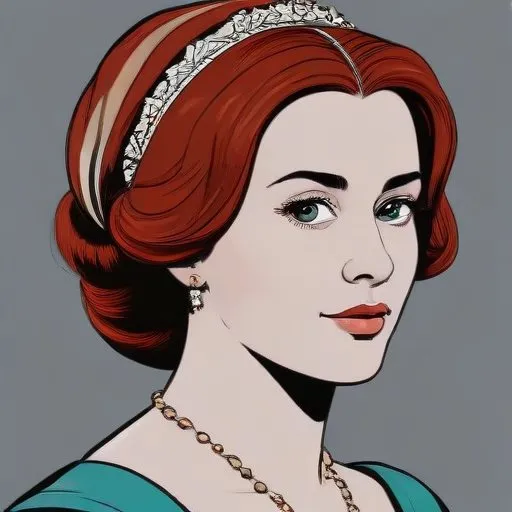
A French duchess who played a significant role in the French Wars of Religion and was a patron of the arts, known for her cultural and political influence.
Anna d'Este was a prominent princess of the 16th century, known for her considerable influence at the court of France and her pivotal role in the French Wars of Religion. As the Duchess of Aumale, Guise, Nemours, and Genevois, she wielded significant power and navigated the complex web of royal politics with aplomb.
Born on November 16, 1531, Anna was the eldest daughter of the Duke of Ferrara, Ercole II, and his wife, Rene of France. She grew up in Ferrara, where she received an excellent education, which laid the foundation for her future diplomatic endeavors. The esteemed writer and scholar, Olympia Fulvia Morata, was chosen as one of her companions at court, further enriching her intellectual pursuits.
In 1548, Anna's marriage was arranged with French prince Francis, Duke of Aumale, son of the Duke of Guise. The contract was signed in Ferrara on September 28, and the marriage took place in Saint-Germain-en-Laye near Paris on December 16. This union catapulted Anna into the powerful Guise family, solidifying her position at the French court. She became the mother of seven children, four of whom reached adulthood.
As the granddaughter of King Louis XII of France, Anna was related to Henry II and his sons, granting her a unique position at court. Her Italian roots also fostered close ties with Queen Catherine de Medici, further amplifying her influence. Following her father-in-law's death in 1550, Anna, as the Duchess of Guise, governed the family estates and enormous fortunes alongside her mother-in-law, Antoinette de Bourbon.
Anna was an astute mediator between the French and Ferraran courts, leveraging her connections to facilitate diplomatic relations. She worked tirelessly on behalf of her father, Ercole II, to maintain harmony between the two nations.
Anna d'Este's life was marked by turbulence and tragedy, including the assassination of her husband, Francis, Duke of Guise, in 1563. Undeterred, she took decisive action to seek justice, albeit unsuccessfully. Her remarkable strength, intelligence, and resilience in the face of adversity have earned her a place in history as a formidable figure of the French Renaissance.
While Anna d'Este's philosophical beliefs are not explicitly documented, her actions and decisions demonstrate a strong sense of duty, loyalty, and justice. Her commitment to her family and her nation suggests a deep-seated belief in the importance of familial bonds and national unity.
Anna d'Este's life and legacy are inextricably linked with the tumultuous era of the French Wars of Religion. Her remarkable influence and diplomatic prowess during this period have earned her a place alongside other prominent female figures of the Renaissance. As a testament to her enduring impact, Anna d'Este remains an important figure in the annals of French history, inspiring generations with her intelligence, determination, and fortitude.
Born in 1519
King of France from 1547 to 1559, known for his cultural and artistic patronage, and his role in the Italian Wars.
Born in 1575
The Queen of France who commissioned the Luxembourg Palace and was the subject of Peter Paul Rubens' famous cycle of paintings, known for her extravagant lifestyle and political influence.
Born in 1785
The last king of the French monarchy before the French Revolution, known for his tragic and mysterious life, including his imprisonment and disputed death.
Born in 1585
A powerful and cunning statesman who dominated French politics during the 17th century, known for his ruthless suppression of dissent and centralization of power. He was a master strategist and diplomat who shaped the course of European history.
Born in 1608
Third son of King Henry IV of France, a rebellious prince who plotted against his brother King Louis XIII and was known for his military prowess and romantic escapades.
Born in 1601
The queen who ruled France alongside her son Louis XIV, known as the Sun King, and played a significant role in shaping the country's politics and culture during the 17th century. She was a skilled diplomat and strategist who helped to establish France as a dominant European power.
Born in 1674
The Regent of France from 1715 to 1723, known for his cultural and artistic patronage, and his role in shaping the country's politics during a period of significant change.
