


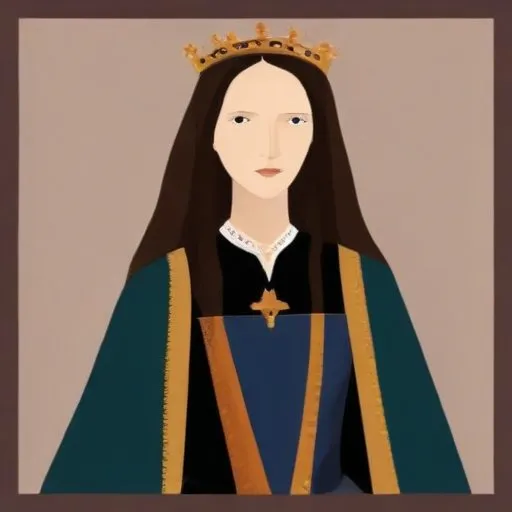
Youngest sister of the missing Princes in the Tower, she played a significant role in the Wars of the Roses and was a pawn in the royal marriage game.
Anne of York, the fifth daughter of King Edward IV of England and his queen consort Elizabeth Woodville, was a valuable diplomatic asset in the tumultuous world of 15th-century royal politics. Born on November 2, 1475, at the Palace of Westminster, Anne's life was marked by uncertainty, illegitimacy, and ultimately, a tragic early demise.
Following the death of her father and the usurpation of the throne by her uncle Richard III, Anne's life took a dramatic turn. At the tender age of eight, she was declared illegitimate, along with her siblings, by an act of parliament. Fearing for their safety, Anne's mother, Elizabeth Woodville, sought refuge for her children at Westminster Abbey, where they spent approximately a year under the protection of the sacred walls.
With the fall of Richard III and the ascension of Henry Tudor (Henry VII) to the throne, Anne's fortunes changed. The act declaring her illegitimate was revoked, and she became a prized commodity in the royal marriage market. Her marriage to a Scottish prince was briefly considered, but ultimately abandoned after the prince's father, King James III, was killed in 1488. This setback was short-lived, as Anne's value as a diplomatic asset continued to grow.
In 1495, Anne married Thomas Howard, a union that had been planned since the time of Richard III. However, the marriage was marked by tragedy, as all their children predeceased them. Anne's own health was precarious, and she died at the age of 36, leaving behind a legacy of what could have been.
Anne's life serves as a testament to the tumultuous nature of royal politics in the 15th century. Her experiences, though marked by illegitimacy and uncertainty, demonstrate the valuable role women played in securing alliances and furthering royal interests.
Anne's story is often overshadowed by that of her more prominent siblings, yet her life provides a unique glimpse into the complexities of royal politics during the Wars of the Roses. Her diplomatic value and personal struggles serve as a poignant reminder of the human costs of royal ambition.
While Anne's personal beliefs and philosophies are not well-documented, her life serves as a testament to the resilient nature of women in the face of adversity. Her experiences, marked by uncertainty and illegitimacy, demonstrate a quiet strength and determination that continues to inspire.
In conclusion, Anne of York's life, though often overlooked, offers a fascinating glimpse into the intricate world of 15th-century royal politics. Her story serves as a poignant reminder of the human costs of royal ambition and the valuable role women played in securing alliances and furthering royal interests.
Born in 1284
The king whose disastrous reign led to his eventual deposition and mysterious death, remembered for his alleged homosexual relationships and power struggles with nobles.
Born in 1367
The last king of the House of Plantagenet, deposed in a coup, known for his extravagance and tyranny, leading to his downfall and the rise of the Lancastrian dynasty.
Born in 1133
King of England from 1154 to 1189, known for establishing a strong centralized government, reforming the English church, and his tumultuous relationships with Thomas Becket and his sons.
Born in 1446
Duchess of Burgundy and sister of King Edward IV of England, known for her lavish lifestyle and patronage of the arts.
Born in 1470
The short-lived king of England who was mysteriously disappeared as a child, sparking one of history's greatest mysteries. His brief reign and unknown fate have captivated historians and fiction writers alike.
Born in 1469
Daughter of King Edward IV, she was a prominent figure in the royal court and a patron of the arts, known for her beauty and lively personality.
