


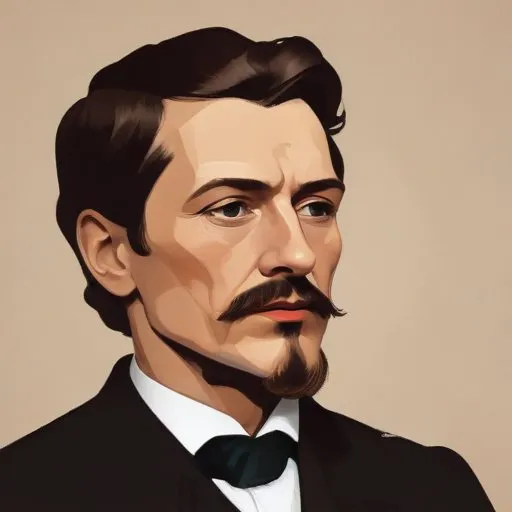
A 19th-century painter celebrated for his vivid, emotive depictions of ancient Greek and Roman mythology, particularly his iconic "Medea" and "Iphigenia" works.
Anselm Feuerbach is renowned for being the leading neoclassical painter of the German 19th-century school, celebrated for his masterful interpretations of classical themes and his bold, vivid use of color. His works continue to inspire and influence artists to this day, cementing his position as one of the most important painters of his era.
Born on September 12, 1829, in Speyer, Germany, Feuerbach was the son of archaeologist Joseph Anselm Feuerbach and the grandson of legal scholar Paul Johann Anselm Ritter von Feuerbach. His early life was marked by a strong cultural and intellectual upbringing, which would later influence his artistic style.
Feuerbach's artistic training began at the Düsseldorf Academy, where he studied under prominent artists such as Johann Wilhelm Schirmer, Wilhelm von Schadow, and Carl Sohn between 1845 and 1848. He then moved on to the Munich Academy, before eventually settling in Antwerp, where he was taught by Gustav Wappers.
In 1851, Feuerbach relocated to Paris, where he was a pupil of Thomas Couture until 1854. This period proved to be a pivotal moment in his artistic development, as he was exposed to the works of the Old Masters and the avant-garde movements of the time. It was in Paris that he created his first masterpiece, Hafiz at the Fountain (1852), which showcased his deep understanding of color and composition.
In 1854, Feuerbach traveled to Venice, where he was deeply influenced by the city's rich artistic heritage and the works of the Italian masters. This experience had a profound impact on his artistic style, leading him to develop a distinctive palette characterized by bold, vivid colors.
During his time in Italy, Feuerbach became associated with the Deutschrömer, a group of German artists who shared his enthusiasm for Italian art and culture. This circle of artists, which included Arnold Böcklin and Hans von Marées, would go on to play a significant role in shaping the development of 19th-century German art.
Feuerbach's later years were marked by a continued commitment to his art, as well as a growing involvement in teaching. In 1873, he was appointed professor of history painting at the Academy of Vienna, where he mentored students such as Ludwig Deutsch, Rudolf Ernst, and Jean Discart.
Throughout his life, Feuerbach produced numerous works that showcased his mastery of neoclassical art. Two of his most famous works, Plato's Symposium (1869-1874), are testament to his ability to breathe new life into ancient themes and motifs.
Anselm Feuerbach's legacy extends far beyond his own artistic achievements. As a teacher and mentor, he played a significant role in shaping the development of German art in the late 19th century. His bold, expressive style continues to inspire artists today, ensuring that his work remains a vital part of the artistic canon.
Anselm Feuerbach's remarkable life and artistic achievements serve as a testament to the power of creative expression and the enduring legacy of neoclassical art.
Born in 1836
A renowned 19th-century painter of portraits and landscapes, capturing the essence of the German aristocracy and landscapes with remarkable realism. His works are celebrated for their intricate details and lifelike quality.
Born in 1848
A German painter and educator, he's most known for his Impressionist and Realist works, often depicting everyday life and landscapes, and for teaching at the Munich Academy of Fine Arts.
