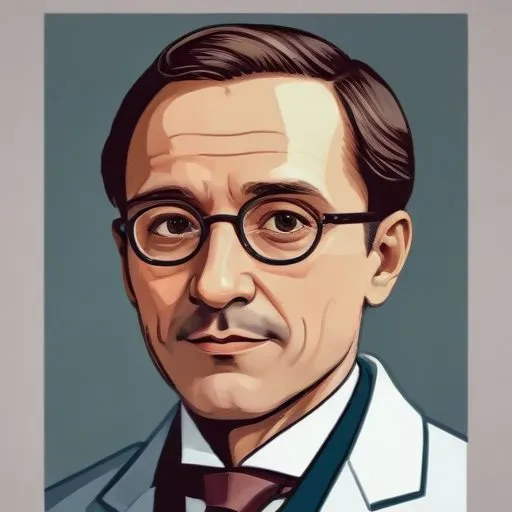
Anselme Payen: The Pioneer of Enzyme Discovery and Carbohydrate Chemistry
Unraveling the Secrets of Nature's Building Blocks
Anselme Payen, a French chemist, is renowned for his groundbreaking discovery of diastase, the first enzyme, and his pioneering work on the carbohydrate cellulose. His innovative research and developments in these areas have had a profound impact on our understanding of the natural world and have paved the way for significant advances in various fields.
Early Life and Education
Born in Paris on January 6, 1795, Payen's fascination with science began at a young age. He started studying science with his father at the age of 13 and later attended the École Polytechnique, where he was mentored by esteemed chemists
Louis Nicolas Vauquelin and Michel Eugène Chevreul.
Breakthroughs and Innovations
At the age of 23, Payen became the manager of a borax-refining factory, where he developed a process for synthesizing borax from soda and boric acid. This innovation allowed him to break the Dutch monopoly on borax and sell it at a significantly lower price. This achievement showcased his exceptional problem-solving skills and entrepreneurial spirit.
Payen's contributions to science didn't stop there. He also developed processes for:
- Refining sugar
- Refining starch and alcohol from potatoes
- Determining nitrogen content
The Discovery of Diastase and Cellulose
Payen's most notable achievement came in 1833 when he discovered the first enzyme, diastase. This breakthrough led to a deeper understanding of biological processes and paved the way for future enzyme research. Additionally, he isolated and named the carbohydrate cellulose, a fundamental component of plant cell walls.
Awards and Legacy
In recognition of his contributions, the American Chemical Society's Cellulose and Renewable Materials Division established the Anselme Payen Award, an annual honor bestowed upon outstanding researchers in the field.
Teaching and Later Life
Payen's academic pursuits led him to become a professor at the École Centrale Paris in 1835 and later at the Conservatoire National des Arts et Métiers. He passed away on May 12, 1871, leaving behind a legacy of innovation and discovery that continues to inspire scientists today.
Through his groundbreaking work, Anselme Payen has left an indelible mark on the fields of chemistry and biology. His discoveries have opened doors to new areas of research and have had a profound impact on our understanding of the natural world.
FAQ
What was Anselme Payens most significant contribution to chemistry?
Anselme Payens most significant contribution to chemistry was the discovery of the enzyme diastase, which breaks down starch into sugar. This discovery laid the foundation for modern biochemistry and the study of enzymes.
How did Anselme Payens work on cellulose affect the textile industry?
Anselme Payens work on cellulose led to significant advances in the textile industry, as it enabled the development of new methods for producing paper and other cellulose-based materials.
What were Anselme Payens achievements as a professor at the École Polytechnique?
As a professor at the École Polytechnique, Anselme Payen taught chemistry and physics to a generation of French scientists, including Louis Pasteur and Marcellin Berthelot.
How did Anselme Payens work on fermentation impact the brewing industry?
Anselme Payens work on fermentation led to a better understanding of the brewing process and the development of new brewing techniques. His work had a significant impact on the brewing industry and the production of beer.
What honors did Anselme Payen receive for his contributions to chemistry?
Anselme Payen received several honors for his contributions to chemistry, including the Copley Medal in 1850 and election to the French Academy of Sciences in 1842.