


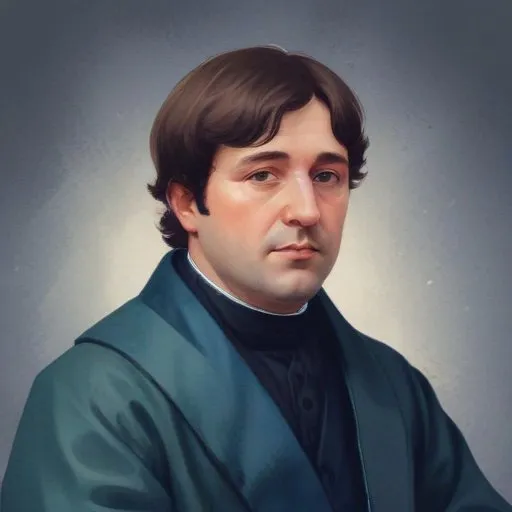
A 17th-century polymath who made significant contributions to mathematics, theology, and philosophy, particularly in the development of probability theory and critiques of Cartesian philosophy.
Antoine Arnauld, known as "le Grand" to distinguish him from his father, was a towering figure in 17th-century French theology and philosophy. He was a prominent Catholic theologian, philosopher, and mathematician, celebrated for his encyclopedic knowledge of patristics and his influential writings on Jansenism.
Born in Paris on February 6, 1612, Antoine Arnauld was the youngest of 20 children in the esteemed Arnauld family. Initially destined for a career in law, he defied his family's expectations and pursued theological studies at the Sorbonne. His academic prowess soon earned him recognition, and his career flourished under the guidance of Jean du Vergier de Hauranne, the spiritual director of the convent of Port-Royal.
Arnauld's most significant contribution to Jansenism came with his book, De la fréquente Communion (1643), which clarified the movement's aims and ideals for the general public. This work sparked controversy by arguing against frequent communion. During the Jansenist controversy, Arnauld wrote Théologie morale des Jésuites, a treatise that laid the groundwork for Pascal's scathing critique of Jesuit casuistry in his Provincial Letters.
Arnauld's erudite writings showcased his mastery of patristics, as well as his proficiency in philosophy and mathematics. His Théologie morale des Jésuites exposed the perceived moral laxity of Jesuit theology, sparking a heated debate that continued for centuries. This work also solidified his reputation as a formidable theologian and philosopher.
Arnauld's influence on modern society extends beyond the realm of theology and philosophy. His commitment to intellectual rigor and critical thinking has inspired generations of scholars and thinkers. His contribution to the development of Jansenism, a movement that emphasized personal holiness and moral rigor, has had a lasting impact on Catholic thought and practice.
Antoine Arnauld's remarkable intellectual achievements have secured his place as one of the most important figures in 17th-century French theology and philosophy. His writings continue to inspire scholars and thinkers, ensuring his legacy as a champion of intellectual rigor and critical thinking.
Through his tireless efforts to clarify the Jansenist movement's principles, Arnauld has left an indelible mark on Catholic thought and practice. His commitment to intellectual honesty and his passion for theology and philosophy have made him an enduring figure in the history of ideas.
Born in 1623
A 17th-century genius who made major contributions to mathematics, physics, and philosophy, inventing the mechanical calculator and developing the theory of probability. His writings also explored the human condition and faith.
Born in 1596
Developed influential philosophical and mathematical concepts, including the famous phrase "I think, therefore I am," and laid the foundation for modern Western philosophy.
Born in 1629
A 17th-century polymath who made groundbreaking contributions to optics, probability theory, and astronomy, including the discovery of Saturn's rings and the largest moon, Titan.
Born in 1646
Developed calculus independently of Isaac Newton, and made major contributions to the fields of philosophy, politics, and history.
Born in 1588
A 17th-century polymath who made significant contributions to mathematics, particularly in the discovery of prime numbers, and wrote extensively on philosophy and theology.
Born in 1627
A 17th-century French bishop and theologian who wrote influential works on theology, politics, and history, shaping the Catholic Church's stance on various issues. He's also known for his eloquent sermons and funeral orations.
