


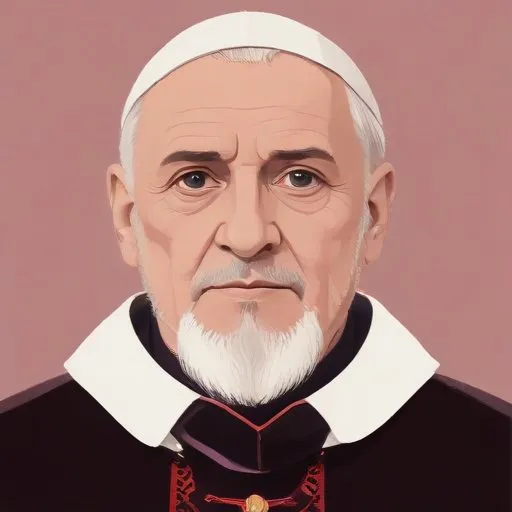
A 17th-century French bishop and theologian who wrote influential works on theology, politics, and history, shaping the Catholic Church's stance on various issues. He's also known for his eloquent sermons and funeral orations.
Jacques-Bénigne Bossuet, a French bishop and theologian, is renowned for his exceptional sermons, addresses, and literary works, earning him a reputation as a brilliant orator and literary stylist of the French language. His mastery of rhetoric and eloquence has made him a legendary figure in the history of French literature.
Born on September 27, 1627, in Dijon, France, Bossuet was the fifth son of a family of prosperous Burgundian lawyers. His early education took place at a Jesuit school, followed by enrollment at the College of Navarre in Paris, where he studied philosophy and theology.
In 1652, Bossuet was ordained a priest and became a Doctor of Divinity. He spent the next seven years in Metz, where he honed his skills in oratory and politics, before returning to Paris and establishing his reputation as a great preacher. By the early 1660s, Bossuet was preaching regularly before the court of King Louis XIV at Versailles, solidifying his position as a prominent figure in French society.
Some of Bossuet's most notable works include:
Bossuet was a strong advocate of political absolutism and the divine right of kings, which influenced his views on the role of the monarchy in French society. Later in his life, he was also involved in the controversies over Gallicanism and Quietism, and supported the king's revocation of the Edict of Nantes, which abolished the rights of the Huguenot Protestant minority.
Bossuet's contributions to French literature and oratory have had a lasting impact on the country's cultural heritage. His literary style, which blended elegance with profundity, has inspired generations of writers and thinkers. His commitment to the values of absolutism and the divine right of kings has shaped the course of French history, influencing the development of the monarchy and the relationship between the church and state.
In 1670, Bossuet was appointed tutor to the Dauphin, and a year later, he was elected to the Académie Française. In 1681, he was appointed Bishop of Meaux, a position he held until his death in 1704 at the age of 76.
Did you know that Bossuet was a talented musician and composer? He even wrote a treatise on music and was known to have played the organ during his sermons.
Despite his passing in 1704, Bossuet's legacy continues to inspire and influence French literature, philosophy, and culture to this day. His remarkable life and achievements serve as a testament to the power of eloquence, wisdom, and dedication to one's craft.
Born in 1710
The monarch who ruled France from 1715 to 1774, known as the "Sun King's" great-grandson, and remembered for his extravagance, absolutism, and the decline of the French monarchy.
Born in 1632
A 17th-century mastermind who revolutionized French opera, creating lavish productions that captivated the royal court and beyond. He's credited with establishing the French opera tradition.
Born in 1622
A 17th-century master of comedy, he penned witty plays that satirized the French aristocracy, leaving a lasting impact on Western theater. His works remain widely performed and adapted today.
Born in 1606
A 17th-century French mastermind behind iconic plays like "Le Cid" and "Horace", known for pioneering the classical French tragedy genre.
Born in 1636
A 17th-century French poet and critic who advocated for reason and morality in literature, and is known for his influential writings on poetry and aesthetics.
Born in 1651
A 17th-century French archbishop and poet who wrote influential works on spirituality and morality, including the famous novel "Telemachus".
Born in 1623
A 17th-century genius who made major contributions to mathematics, physics, and philosophy, inventing the mechanical calculator and developing the theory of probability. His writings also explored the human condition and faith.
