


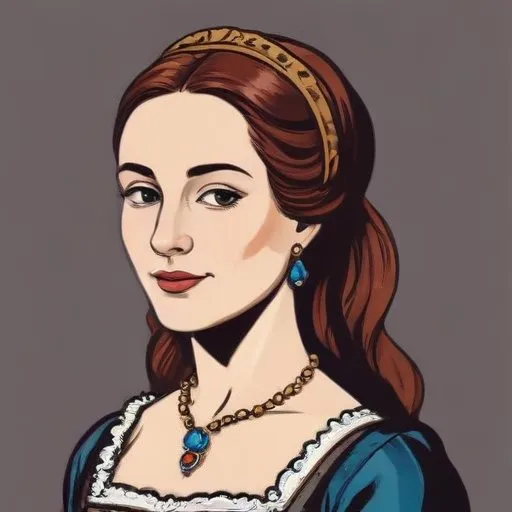
A French noblewoman who played a significant role in the French Wars of Religion, particularly in the Huguenot rebellions, and was known for her strong will and strategic alliances.
Antoinette de Bourbon, the Duchess of Guise, was a force to be reckoned with in 16th-century France. This stunning beauty and shrewd politician was known for her unwavering courage, unrelenting ambition, and unapologetic extravagance, earning her the reputation as one of the most captivating and influential women of her time.
Born on December 25, 1493, Antoinette was the daughter of Francis, Count of Vendôme, and Marie de Luxembourg. Her royal lineage and family connections ensured her a life of opulence and privilege from the very beginning. Growing up amidst the aristocracy, Antoinette developed a taste for the finer things in life, which would become a hallmark of her later years.
In 1513, Antoinette married Charles, Duke of Guise, a powerful and ambitious nobleman. This strategic union propelled her into the heart of French politics, and she soon became a key player in the Guise family's quest for power and prestige. Antoinette's intelligence, charm, and beauty made her an indispensable ally and advisor to her husband, and eventually, a driving force behind the Guise family's rise to prominence.
Antoinette was a devout Catholic and a strong supporter of the Catholic Church. Her faith played a significant role in shaping her political views and influencing her decisions throughout her life. While she was not a philosopher in the classical sense, her unwavering commitment to her beliefs and her unshakeable conviction in the face of adversity demonstrate a profound philosophical depth.
Antoinette's flamboyant style, unwavering confidence, and unapologetic ambition have inspired countless women throughout history. Her legacy extends beyond the realm of politics, influencing the way women approach power, fashion, and social status. She remains an icon of feminine strength and a testament to the enduring power of women in politics.
Antoinette's penchant for luxury and extravagance often led to criticism and scrutiny. Her family's relentless pursuit of power and influence sparked controversy and even violence, earning them numerous enemies and critics. Despite this, Antoinette remained unapologetic and unyielding, refusing to compromise her values or her way of life.
Antoinette's life and legacy are inextricably linked to the tumultuous landscape of 16th-century France. Her influence on the Guise family's rise to power, her role in the French Wars of Religion, and her unwavering commitment to her faith and her values cement her place as one of the most fascinating and formidable women of the Renaissance.
In conclusion, Antoinette de Bourbon, the Duchess of Guise, was a true original – a woman of unwavering conviction, unrelenting ambition, and unapologetic extravagance. Her legacy continues to inspire and captivate, serving as a testament to the enduring power of women in politics and beyond.
Born in 1519
King of France from 1547 to 1559, known for his cultural and artistic patronage, and his role in the Italian Wars.
Born in 1575
The Queen of France who commissioned the Luxembourg Palace and was the subject of Peter Paul Rubens' famous cycle of paintings, known for her extravagant lifestyle and political influence.
Born in 1785
The last king of the French monarchy before the French Revolution, known for his tragic and mysterious life, including his imprisonment and disputed death.
Born in 1585
A powerful and cunning statesman who dominated French politics during the 17th century, known for his ruthless suppression of dissent and centralization of power. He was a master strategist and diplomat who shaped the course of European history.
Born in 1608
Third son of King Henry IV of France, a rebellious prince who plotted against his brother King Louis XIII and was known for his military prowess and romantic escapades.
Born in 1601
The queen who ruled France alongside her son Louis XIV, known as the Sun King, and played a significant role in shaping the country's politics and culture during the 17th century. She was a skilled diplomat and strategist who helped to establish France as a dominant European power.
Born in 1674
The Regent of France from 1715 to 1723, known for his cultural and artistic patronage, and his role in shaping the country's politics during a period of significant change.
Born in 1710
The monarch who ruled France from 1715 to 1774, known as the "Sun King's" great-grandson, and remembered for his extravagance, absolutism, and the decline of the French monarchy.
