


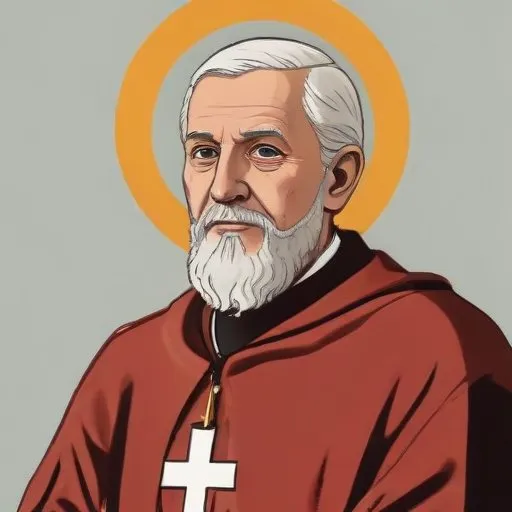
The 23rd Superior General of the Society of Jesus, a Swiss religious leader, oversaw the Jesuit order's global missionary and educational efforts, shaping Catholicism's modern face. He played a crucial role in the order's survival during a tumultuous period.
Anton Anderledy was a renowned Swiss Jesuit who served as the 23rd Superior General of the Society of Jesus, leading the order through a period of turmoil and reform. He is known for his unwavering commitment to the Jesuit mission, his linguistic expertise, and his ability to navigate challenging circumstances.
Born on June 3, 1819, in Switzerland, Anderledy was the son of a postal services director. He entered the Jesuit novitiate at Brig in 1838, where he began his spiritual and academic journey.
When the Jesuits were expelled from Switzerland in 1847, Anderledy, along with fifty others, was forced to flee to the United States. He completed his theological studies in St. Louis, Missouri, and was ordained as a priest on September 29, 1848, by Archbishop Peter Richard Kenrick.
Anderledy dedicated himself to serving the German migrants in Green Bay, Wisconsin, for two years (1848-1850). He then returned to Europe, where he made his final year of formation in Drongen, Belgium, and later joined the missionary band led by Father Peter Roh in Germany.
Anderledy's term as Provincial was marked by significant achievements, including the purchase of the medieval abbey of Maria Laach, near Bonn, which became the province house of higher studies.
Anderledy's life was characterized by resilience, adaptability, and a deep commitment to the Jesuit values. His ability to navigate challenging circumstances, coupled with his linguistic expertise and missionary zeal, made him an effective leader and a shining example for the Jesuit community.
Anton Anderledy's remarkable life and legacy continue to inspire generations of Jesuits and Catholics around the world, serving as a testament to the power of faith, perseverance, and dedication to a higher purpose.
Born in 1810
The first pope to fully embrace modernity, he issued the groundbreaking encyclical Rerum Novarum, which addressed social justice and workers' rights, shaping the Catholic Church's stance on social issues.
Born in 1504
Leader of the Catholic Church during the Counter-Reformation, he excommunicated Queen Elizabeth I and played a key role in the Council of Trent.
Born in 1876
The leader of the Catholic Church from 1939 to 1958, known for his controversial role during World War II, particularly in regards to the Holocaust. He is also remembered for his encyclicals on social justice and liturgical reforms.
Born in 1881
Reformed the Catholic Church, introducing progressive reforms and ecumenical dialogue, and convened the Second Vatican Council.
Born in 1417
A 15th-century pope who played a significant role in the fall of the Western Schism, ending the division in the Catholic Church. He's also known for his lavish spending and nepotism.
Born in 1920
Leader of the Catholic Church from 1978 to 2005, known for helping to end communism in Poland and being a charismatic advocate for human rights and social justice.
90 Years Old
The 13th Superior General of the Society of Jesus, a Spanish priest, led the Jesuit order, promoting education, social justice, and interfaith dialogue, while navigating complex Church politics. He was a key figure in modernizing the Jesuit order.
Born in 1506
Co-founder of the Society of Jesus, a Catholic religious order, known for his missionary work in Asia, especially in India and Japan, and for his role in the Counter-Reformation. He's revered for his tireless efforts to spread Christianity and his compassion for the poor and marginalized.
