


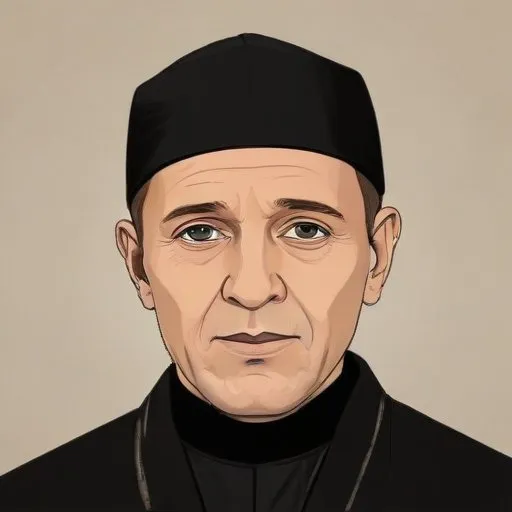
Austrian priest and activist who fought against Nazi regime, saving hundreds of Jews during WWII, and later became a vocal critic of Austria's handling of its Nazi past.
Anton Fster, a Slovene-born Austrian Roman Catholic priest, theologian, and pedagogue, is best known for his instrumental role in the 1848 Viennese March Revolution, a pivotal event that shaped the course of European history. As a fiery orator and advocate for democracy, Fster's impassioned sermons and writings inspired a generation of students and intellectuals to demand reform and challenge the authoritarian regimes of the time.
Born on January 5, 1808, in Radovljica, Carniola (now in Slovenia), Fster was consecrated as a priest in 1832 in Ljubljana. He was part of the esteemed intellectual circle of Matija Čop, where he befriended the celebrated poet France Prešeren. This formative period laid the foundation for his future involvement in the Slovene national movement and his commitment to progressive ideals.
In 1839, Fster moved to Gorizia, where he became a professor of religion and pedagogy at the State Gymnasium. It was during this period that he established a close friendship with fellow Slovene priest and activist Valentin Stanič and became an active member of Stanič's Association against the Torture of Animals, one of the first animal rights movements in Central Europe. Fster's dedication to humanitarian causes and social justice was already evident in his early career.
In 1847, Fster was appointed professor of philosophy at the University of Vienna, where he began to promote democratic ideas among his students. On Sunday, March 12, 1848, Fster delivered a sermon that would change the course of history. He urged his students to take to the streets the following day, sparking the Viennese March Revolution. This pivotal event marked the beginning of a wave of protests and uprisings that swept across Europe, demanding reform and greater liberties.
Fster's role in the revolution went beyond mere rhetoric. He became a chaplain of the insurgent Academic Guard and fought alongside students on the barricades. His commitment to the cause was unwavering, and he remained a fervent advocate for democracy and national unity throughout the tumultuous months that followed.
Fster's contributions to the Slovene national movement were significant. He was among the academicians who published the manifesto for a United Slovenia in April 1848, a testament to his belief in the power of unity and self-determination. Though he eventually distanced himself from romantic nationalism, Fster's legacy as a champion of democracy and human rights remains unwavering.
Fster's influence on modern society is undeniable. His sermon on March 12, 1848, ignited a flame of resistance that continues to inspire social and political activism today. As a pioneer of the animal rights movement and a champion of national unity, Fster's work has left an indelible mark on European history.
Fster's life and work serve as a testament to the power of conviction and the importance of standing up for one's beliefs. His legacy continues to inspire generations, reminding us that even in the face of adversity, courage and determination can change the course of history.
Born in 1906
A German pastor and theologian who resisted the Nazi regime, writing influential books on faith and ethics, and ultimately giving his life for his convictions.
Born in 1897
The 15th Federal Chancellor of Austria, a strong opponent of Nazi Germany, who tried to maintain Austria's independence before its annexation in 1938. He's known for his courageous but ultimately unsuccessful resistance against Hitler's regime.
Born in 1879
A German nobleman who served as Chancellor of Germany in 1932, known for his role in appointing Adolf Hitler as Chancellor, paving the way for the Nazi regime.
