


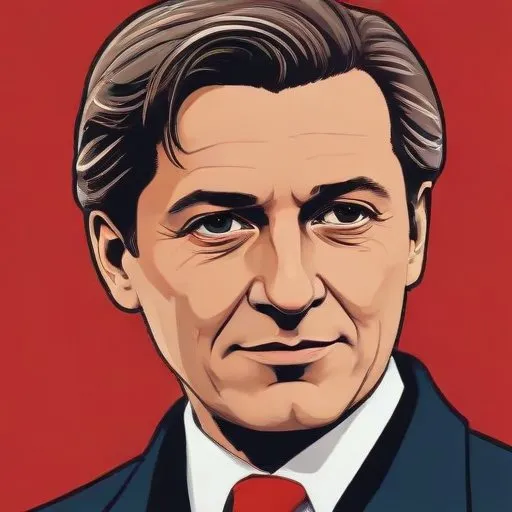
The 15th Federal Chancellor of Austria, a strong opponent of Nazi Germany, who tried to maintain Austria's independence before its annexation in 1938. He's known for his courageous but ultimately unsuccessful resistance against Hitler's regime.
Kurt Schuschnigg, an Austrian politician, is renowned for his courageous stance against Nazi Germany's annexation of Austria, known as the Anschluss. As the Chancellor of Austria from 1934 to 1938, he fought to maintain Austria's independence, ultimately leading to his resignation and imprisonment.
Born on December 14, 1897, in Riva del Garda, Austria-Hungary (now in Trentino, Italy), Schuschnigg was the son of Anna Josefa Amalia Wopfner and Austrian General Artur von Schuschnigg. He belonged to a long-established Austrian officers' family of Carinthian Slovene descent. After completing his education at the Stella Matutina Jesuit College in Feldkirch, Vorarlberg, he was taken prisoner during World War I and held captive until September 1919.
After the war, Schuschnigg studied law at the University of Freiburg and the University of Innsbruck, becoming a member of the Catholic fraternity A.V. Austria. He began his political career in 1927, joining the right-wing Christian Social Party and becoming the youngest parliamentary deputy in the Nationalrat. Suspecting the paramilitary Heimwehr organization, he established the Catholic Ostmarkische Sturmscharen forces in 1930.
As Chancellor, Schuschnigg implemented several policies to maintain Austria's independence, including the formation of the Fatherland Front, a national unity government. However, his efforts were ultimately unsuccessful, and Austria was annexed by Nazi Germany in 1938. Refusing to cooperate with the Nazi regime, Schuschnigg resigned as Chancellor, leading to his arrest and imprisonment.
Schuschnigg was held in solitary confinement and eventually interned in various concentration camps, including Sachsenhausen and Dachau. He was liberated in 1945 by the advancing United States Army and spent most of the rest of his life in academia in the United States.
Schuschnigg gained American citizenship in 1956 and continued to work as a professor of political science at Saint Louis University. He passed away on November 18, 1977. His legacy is marked by his courageous resistance against Nazi Germany, making him a hero in Austrian history.
Schuschnigg's leadership and courage are often compared to those of his predecessor, Engelbert Dollfuss, who was assassinated by Nazi agents in 1934. While both leaders fought to maintain Austria's independence, Schuschnigg's unwavering stance against Nazi Germany sets him apart as a champion of democracy and freedom.
Schuschnigg's story serves as a poignant reminder of the risks and consequences of standing up against oppressive regimes. His legacy continues to inspire leaders and individuals around the world to fight for democracy, freedom, and human rights.
Born in 1892
Leader of Austria during the 1930s, implemented authoritarian regime, and assassinated by Nazi agents. Known for his anti-Nazi stance and attempts to preserve Austrian independence.
Born in 1879
A German nobleman who served as Chancellor of Germany in 1932, known for his role in appointing Adolf Hitler as Chancellor, paving the way for the Nazi regime.
Born in 1870
Austrian lawyer and politician who served as the 4th President of Austria, known for his role in establishing the country's post-WWII government and drafting its constitution. He played a key role in Austria's transition to democracy.
Born in 1902
Chancellor of Austria from 1945 to 1953, he played a crucial role in rebuilding the country after World War II and was a key figure in Austrian politics during the post-war period.
Born in 1891
An Austrian engineer and politician who served as Chancellor of Austria from 1953 to 1961, known for leading the country to independence and economic growth after World War II. He played a key role in shaping Austria's post-war identity and rebuilding its economy.
Born in 1890
The 6th President of Austria, a decorated war hero, and a unifying figure who played a crucial role in rebuilding the country after World War II. He's most known for his efforts to maintain Austrian neutrality during the Cold War.
