


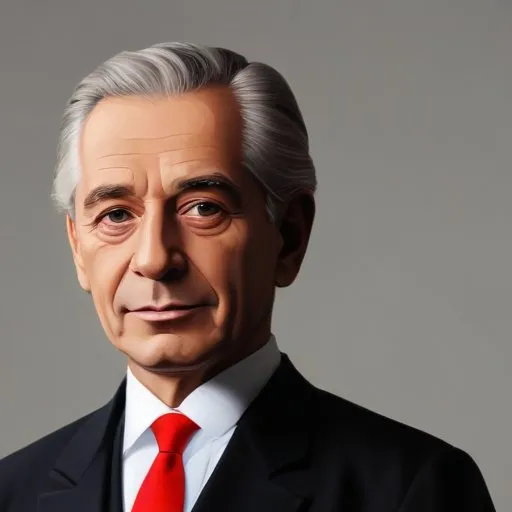
Austrian lawyer and politician who served as the 4th President of Austria, known for his role in establishing the country's post-WWII government and drafting its constitution. He played a key role in Austria's transition to democracy.
Karl Renner, an Austrian politician and jurist, is often revered as the Father of the Republic for his instrumental role in shaping the first government of the Republic of German-Austria and the First Austrian Republic, and later, the Second Republic after World War II.
Born on December 14, 1870, in Unter-Tannowitz, Moravia (present-day Czech Republic), Renner was the 18th child of an ethnic German family of poor winegrowers. His intelligence earned him a place at a selective gymnasium in nearby Nikolsburg, where one of his teachers was Wilhelm Jerusalem. He later attended the University of Vienna, studying law from 1890 to 1896.
In 1896, Renner joined the Social Democratic Workers Party of Austria (SDAP), swiftly becoming a prominent figure in the party. From 1907 to 1918, he represented the SDAP in the National Council, during which time he founded and edited the party's journal, Der Kampf, alongside Otto Bauer and Adolf Braun. Renner's passion for politics also led him to become a librarian for the Reichsrat.
Renner's innovative ideas on law, published under pseudonyms such as Synopticus and Rudolf Springer, demonstrated his commitment to the Austrian state. He fervently believed in the state's existence on geographical, economic, and political grounds. His stance on the nationality question advocated for personal autonomy, showcasing his dedication to the Austrian people.
Renner's leadership was instrumental in establishing the First Republic of Austria in 1919 and 1920. After World War II, he played a pivotal role in founding the Second Republic, becoming its first President in 1945. Throughout his career, Renner stood as a beacon of hope for the Austrian people, earning him the revered title of Father of the Republic.
Karl Renner's tireless efforts in shaping Austria's political landscape have had a lasting impact on modern society. His commitment to democracy and personal autonomy continues to inspire generations, solidifying his legacy as a champion of human rights and freedom.
As the Father of the Republic, Karl Renner's influence extends far beyond his own lifetime. His pioneering spirit and dedication to the Austrian people have created a lasting impact on the country's history, cementing his place as one of the most revered figures in Austrian politics.
Born in 1791
A German war hero and writer, known for his patriotic poetry and novels that inspired the German resistance during World War II.
Born in 1890
The 6th President of Austria, a decorated war hero, and a unifying figure who played a crucial role in rebuilding the country after World War II. He's most known for his efforts to maintain Austrian neutrality during the Cold War.
Born in 1881
A leading figure in Austrian socialism, he played a key role in shaping the country's post-WWI government and was a prominent advocate for democratic socialism. His writings on Marxism and nationalism remain influential.
Born in 1892
Leader of Austria during the 1930s, implemented authoritarian regime, and assassinated by Nazi agents. Known for his anti-Nazi stance and attempts to preserve Austrian independence.
Born in 1897
The 15th Federal Chancellor of Austria, a strong opponent of Nazi Germany, who tried to maintain Austria's independence before its annexation in 1938. He's known for his courageous but ultimately unsuccessful resistance against Hitler's regime.
Born in 1902
Chancellor of Austria from 1945 to 1953, he played a crucial role in rebuilding the country after World War II and was a key figure in Austrian politics during the post-war period.
