


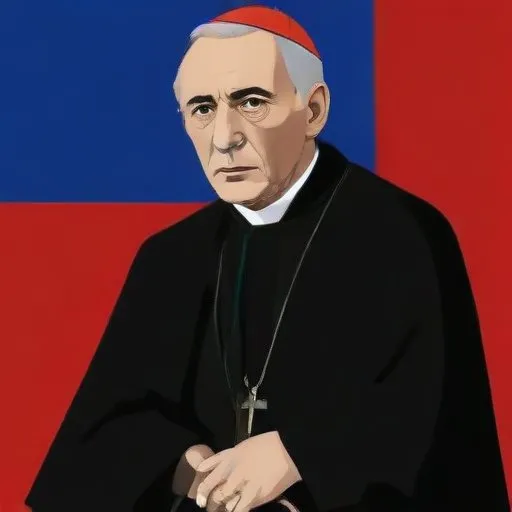
A Slovenian priest and politician who served as the tenth Prime Minister of Yugoslavia, known for his efforts to unite the country's diverse ethnic groups. He played a key role in shaping Yugoslavia's interwar period.
As a prominent member of the conservative People's Party, Anton Koroec is renowned for his instrumental role in shaping the political landscape of Yugoslavia during the early 20th century. His tireless efforts to unify the South Slavic nations under a single state, coupled with his exceptional oratory skills, earned him widespread recognition and respect.
Born on May 12, 1872, in Biserjane, Duchy of Styria, Austria-Hungary (now part of Slovenia), Koroec's formative years were marked by a strong passion for education. He pursued his academic interests in Ptuj and Maribor, before studying theology and being ordained as a priest in 1895. His academic prowess was further solidified with a doctorate in theology from the University of Graz in 1905.
Koroec's foray into politics began in 1907 when he was elected to the Reichsrat as a member of the Slovenian People's Party. This marked the onset of his unwavering commitment to the unity of South Slavic nations. As president of the Yugoslav Club, he read out the May Declaration, a historic document that called for the unification of all South Slavs within the Austro-Hungarian monarchy.
Following the dissolution of Austria-Hungary, Koroec, as president of the National Council of Slovenes, Croats and Serbs, declared the creation of the State of Slovenes, Croats and Serbs on October 29, 1918. This unprecedented move was a significant step towards realizing his vision of a unified South Slavic state.
Koroec's collaboration with Nikola Pai led to the Geneva Declaration, which recognized the equal rights of the different components of such a state should it join with the Kingdom of Serbia in a confederation. However, the subsequent Kingdom of Serbs, Croats and Slovenes, established in 1918, deviated from Koroec's vision of a federal state, instead adopting a unitary monarchy framework.
As vice-president in the first government of the Kingdom of Serbs, Croats and Slovenes in 1918, Koroec continued to advocate for the rights and interests of Slovenes and Croats. He later collaborated in two right-leaning governments, serving as vice-president of the government and minister for the interior in 1924 and 1927, respectively.
Koroec's relentless pursuit of South Slavic unity, combined with his exceptional leadership qualities, has left an indelible mark on the region's political history. His vision, although not fully realized during his lifetime, continues to inspire generations of politicians and scholars alike.
Koroec's remarkable life and career serve as a testament to his unrelenting dedication to the pursuit of South Slavic unity. His legacy continues to inspire and informs contemporary debates on regional cooperation and integration.
Born in 1892
Led the Yugoslav Partisans to victory in World War II and later became a unifying figure, serving as the President of Yugoslavia from 1953 to 1980. He's known for his unique blend of communist and nationalist policies.
Born in 1910
A Slovene general, economist, and politician who played a key role in shaping Yugoslavia's post-WWII economy and foreign policy, and is known for his efforts to decentralize the Yugoslav government.
Born in 1881
A Yugoslav politician who served as the President of the Yugoslav National Assembly and played a key role in the country's unification and post-WWII reconstruction.
Born in 1925
A Slovene poet, writer, translator, journalist, and politician who made significant contributions to Slovenian literature and culture, known for his lyrical poetry and literary translations.
