


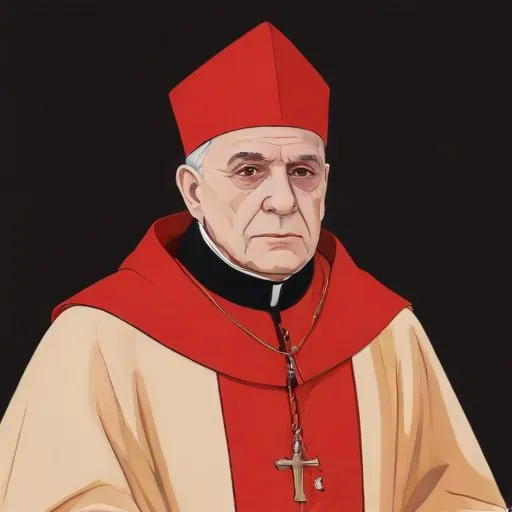
A powerful and influential Catholic Church leader, known for his significant role in the papal conclave and his family's rise to prominence during the 17th century.
As one of the most influential figures of 17th century Italy, Antonio Barberini was a multifaceted personality who left an indelible mark on the world of politics, religion, art, and music. As a cardinal, he played a significant role in shaping the papal conclaves of the century, while his patronage of the arts and support for France made him a prominent member of the House of Barberini.
Born on August 5, 1607, in Rome, Antonio Barberini was the youngest of six children to Carlo Barberini and Costanza Magalotti. Like his brothers, he received his education at the prestigious Collegio Romano, laying the foundation for his future roles in the church and politics.
When his uncle, Maffeo Barberini, was elected as Pope Urban VIII in 1623, Antonio's fate was sealed. Urban VIII's famous nepotism led to the elevation of Antonio's older brother, Francesco Barberini, to the rank of cardinal, and soon after, Antonio himself was appointed as a cardinal at the tender age of 20. This appointment was made in pectore and was published on February 7, 1628, marking the beginning of Antonio's illustrious career in the church.
Antonio Barberini's love for the arts was evident in his patronage of artists, musicians, and writers. He supported the works of famous artists like Gian Lorenzo Bernini and Pietro da Cortona, and his palace in Rome became a hub for intellectuals and creatives. As a military leader, he played a key role in the Wars of Castro and the First War of Castro, demonstrating his strategic prowess and bravery on the battlefield.
Through his various roles, Antonio Barberini helped shape the politics, religion, art, and music of 17th century Italy. Alongside his brothers, Cardinal Francesco Barberini and Taddeo Barberini, he played a significant role in shaping the cultural and intellectual landscape of the time. His legacy extends beyond his own lifetime, influencing generations to come and cementing the Barberini family's place in history.
Antonio Barberini's patronage of the arts and support for France helped lay the groundwork for the cultural and artistic developments of the following centuries. His military leadership and strategic prowess inspired future generations of military leaders, while his role in shaping the papal conclaves of the 17th century remains an important part of church history.
"The arts are the soul of humanity, and those who support them are the guardians of our collective spirit."
Antonio Barberini's life and career were deeply intertwined with the tumultuous events of 17th century Italy. From the Thirty Years' War to the Wars of Castro, he navigated the complexities of politics and war with ease, leaving behind a legacy that continues to inspire and influence to this day.
Born in 1568
The 17th-century Catholic leader who reigned for 21 years, known for his strong stance against Galileo Galilei and his scientific discoveries, as well as his extensive patronage of the arts.
Born in 1611
Led the Catholic Church during a tumultuous period, reforming the Church's finances and combating corruption, while also opposing the French monarch's attempts to exert control over the Church.
Born in 1431
Ruthless and cunning, this Pope was infamous for his corrupt and immoral ways, using his power to further his family's interests.
Born in 1590
The 254th Pope, a strong advocate for the Catholic Church's authority, known for his papal bull condemning the doctrine of probabilism.
Born in 1590
The 254th Pope, a strong advocate for the Catholic Church's authority, known for his papal bull condemning the doctrine of probabilism.
Born in 1611
Led the Catholic Church during a tumultuous period, reforming the Church's finances and combating corruption, while also opposing the French monarch's attempts to exert control over the Church.
Born in 1599
A 17th-century pope who commissioned grand architectural projects, including the colonnade of St. Peter's Square, and was a patron of the arts.
