


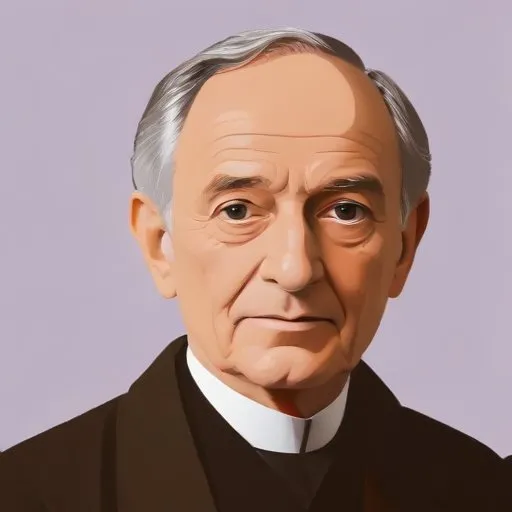
A prominent philosopher who challenged atheism with his groundbreaking work, "There Is a God: How the World's Most Notorious Atheist Changed His Mind", sparking intense debates on the existence of God.
Antony Flew, a renowned English philosopher, is best known for his dramatic shift from atheism to deism, sending shockwaves throughout the philosophical and academic communities. Throughout his illustrious career, Flew made significant contributions to the philosophy of religion, leaving an indelible mark on the field.
Born on February 11, 1923, in London, England, Flew pursued his academic interests at St. John's College, Oxford, where he earned his Bachelor's degree in Philosophy, Politics, and Economics. He went on to teach philosophy at several prestigious universities, including Oxford, Aberdeen, Keele, and Reading in the UK, as well as York University in Toronto, Canada.
Flew was a stalwart advocate of analytic and evidentialist philosophies, focusing on the philosophy of religion. For most of his career, he championed atheism, arguing that one should presume atheism until empirical evidence presents itself. He also critiqued the concept of life after death, the free will defense to the problem of evil, and the meaningfulness of the concept of God. One of his notable contributions is the development of the "No True Scotsman" fallacy, a concept still widely referenced today.
In 2004, Flew stunned his peers by announcing that he had altered his stance on God's existence. He now believed in an intelligent designer of the universe, subscribing to Deism, specifically the Aristotelian God. Flew attributed this shift to his commitment to following the evidence, regardless of personal convictions.
Flew's philosophical contributions have had a significant impact on modern society. His debates on retrocausality with Michael Dummett and his critique of the free will defense have shaped the discourse on the problem of evil. His eventual conversion to Deism has sparked intense discussions on the nature of God and the role of evidence in philosophical inquiry.
Flew has authored numerous influential works, including God and Philosophy (1966) and There is a God: How the World's Most Notorious Atheist Changed His Mind (2007). The latter, co-written with Roy Abraham Varghese, outlines his reasons for embracing Deism and features a chapter on the resurrection of Jesus.
Flew's change of heart sparked controversy, with some critics questioning his mental acuity and suggesting that his co-author, Varghese, had undue influence on his work. Flew vehemently denied these allegations, reaffirming his intellectual independence and commitment to following the evidence.
Flew's legacy extends beyond his philosophical contributions to his impact on the lives of those he influenced. His courageous willingness to challenge his own convictions serves as a beacon for intellectual honesty and open-mindedness. In comparison to his contemporaries, Flew's commitment to evidence-based reasoning and his willingness to evolve his beliefs set him apart as a truly remarkable thinker.
Away from the academic sphere, Flew was a dedicated husband and father. He passed away on April 8, 2010, leaving behind a rich intellectual heritage and a profound impact on the world of philosophy.
Antony Flew's remarkable journey from atheism to Deism serves as a testament to the power of intellectual curiosity and the importance of evidence-based reasoning. His legacy continues to inspire philosophers, thinkers, and scholars, ensuring that his work remains a vital part of ongoing discussions on the nature of God, evidence, and human understanding.
Born in 1910
A prominent logical positivist, he championed the idea that only verifiable statements are meaningful, and his book "Language, Truth, and Logic" remains a seminal work in 20th-century philosophy.
Born in 1872
A renowned thinker who made significant contributions to mathematics, philosophy, and social commentary, known for his influential writings on logic, ethics, and politics. He's a prominent figure in shaping modern intellectual thought.
Born in 1900
A philosopher who challenged traditional views on the mind-body problem, proposing a more holistic approach to understanding human behavior and consciousness. He's known for his concept of "category mistake."
Born in 1911
Developed the concept of "speech acts" and argued that language is not just about conveying information, but also about performing actions and creating social relationships.
Born in 1909
A Latvian-English historian and philosopher who explored the intersection of philosophy, history, and politics, and is renowned for his work on the Enlightenment, liberty, and the nature of humanity.
Born in 1922
A Hungarian mathematician and philosopher who developed the concept of "methodology of scientific research programs" and critiqued the traditional notion of scientific progress. He's known for his work on the philosophy of mathematics and science.
Born in 1924
A provocative philosopher who challenged traditional notions of science, reason, and knowledge, arguing that there is no single, objective truth. He's known for his anarchic approach to epistemology and his critique of scientific methodology.
Born in 1922
A physicist-turned-historian who challenged traditional notions of scientific progress, arguing that paradigm shifts occur in revolutionary leaps rather than gradual accumulation of knowledge. He's famous for his book "The Structure of Scientific Revolutions".
