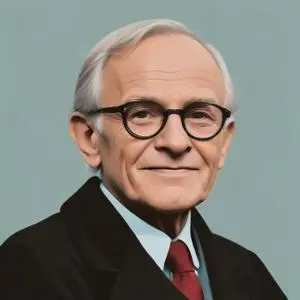
Paul Feyerabend

Paul Feyerabend

Paul Feyerabend was born on January 13th, 1924

Full Name: Paul Karl Feyerabend
Nationality: Austrian, Swiss
Occupation: Philosopher, Academic
Notable Work: Against Method
Birth Year: 1924
Place of Birth: Vienna, Austria
Death Year: 1994
Field: Philosophy of Science

A provocative philosopher who challenged traditional notions of science, reason, and knowledge, arguing that there is no single, objective truth. He's known for his anarchic approach to epistemology and his critique of scientific methodology.

Timeline
1924
Born in Vienna
Paul Feyerabend was born on January 13, 1924, in Vienna, Austria. He would go on to become an Austrian-Swiss philosopher and academic.
1947
Earned Ph.D. in Philosophy
Feyerabend earned his Ph.D. in philosophy from the University of Vienna in 1947.
1958
Taught at University of California
Feyerabend taught at the University of California, Berkeley from 1958 to 1989, influencing a generation of philosophers and scientists.
1975
Published Against Method
Feyerabend published his influential book Against Method in 1975, challenging traditional notions of scientific inquiry.
1994
Passed Away
Paul Feyerabend passed away on February 11, 1994, at the age of 70, leaving behind a legacy of provocative ideas and philosophical debates.
Paul Feyerabend

Paul Feyerabend Quiz

What is Paul Feyerabend's approach to epistemology known as?

Score: 0/5
FAQ
What was Paul Feyerabends area of expertise?
Paul Feyerabend was an Austrian-Swiss philosopher of science, known for his critiques of scientific methodology and his advocacy for anarchism in science.
What was Paul Feyerabends most influential work?
Paul Feyerabends most influential work is his 1975 book Against Method, which argues against the idea of a single, universal scientific method.
Did Paul Feyerabend receive any notable awards?
Yes, Paul Feyerabend received several awards for his work, including the Lakatos Award.
What was Paul Feyerabends early life like?
Paul Feyerabend was born in Vienna, Austria, and studied physics and philosophy at the University of Vienna.
How is Paul Feyerabends work remembered in philosophy of science?
Paul Feyerabends work is remembered as a significant challenge to traditional notions of scientific methodology and objectivity, and has influenced generations of philosophers and scientists.

Related People:

Imre Lakatos

Born in 1922

A Hungarian mathematician and philosopher who developed the concept of "methodology of scientific research programs" and critiqued the traditional notion of scientific progress. He's known for his work on the philosophy of mathematics and science.

Thomas Kuhn

Born in 1922

A physicist-turned-historian who challenged traditional notions of scientific progress, arguing that paradigm shifts occur in revolutionary leaps rather than gradual accumulation of knowledge. He's famous for his book "The Structure of Scientific Revolutions".

Bertrand Russell

Born in 1872

A renowned thinker who made significant contributions to mathematics, philosophy, and social commentary, known for his influential writings on logic, ethics, and politics. He's a prominent figure in shaping modern intellectual thought.

Ludwig Wittgenstein

Born in 1889

A philosopher who challenged traditional philosophy by emphasizing the importance of language and its limits, and is famous for his philosophical ideas on logic, reality, and the nature of meaning.

Martin Heidegger

Born in 1889

A German philosopher and academic who explored the meaning of existence, time, and human existence, influencing 20th-century philosophy with his concept of "Being-in-the-world".

Jean-Paul Sartre

Born in 1905

Existentialist philosopher and playwright who argued that humans have complete freedom to choose their actions and create their own meaning in life, influencing modern thought on morality and individual responsibility.

Albert Einstein

Born in 1879

A brilliant physicist who developed the theory of relativity and is considered one of the most influential scientists of the 20th century, known for his groundbreaking work in physics and mathematics.