


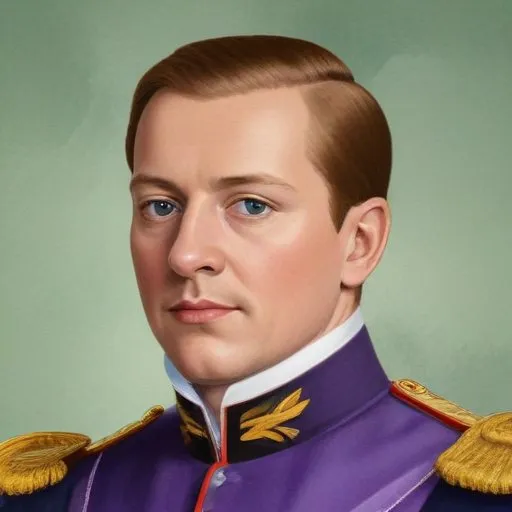
Austrian field marshal who played a key role in the Austro-Prussian War and later became the Inspector General of the Imperial and Royal Army. He's also known for his extensive art collection.
Archduke Albrecht Friedrich Rudolf Dominik of Austria, Duke of Teschen, is famously known for his 36-year tenure as Inspector General of the Austro-Hungarian Army, earning him the reputation as a stalwart conservative who delayed modernization and played a significant role in the army's eventual downfall.
As one of Emperor Francis Joseph I's chief military advisors, Archduke Albrecht was a towering figure in the Austro-Hungarian Empire, honored with the rank of Field Marshal in both Austria-Hungary (1863) and Germany (1893). However, his rigid adherence to traditional military tactics and his resistance to innovation have been cited by historians as a major contributor to the empire's failures in World War I.
Born on August 3, 1817, in Vienna, Archduke Albrecht was the eldest son of Archduke Charles of Austria, the victorious commander at the Battle of Aspern-Essling against Napoleon I in 1809. His father's military prowess and influence shaped Albrecht's early life, encouraging his innate military disposition.
Albrecht entered the Austrian army in 1837, with Feldmarschall Joseph Radetzky as his military governor. He received a thorough military education, swiftly rising through the ranks: Generalmajor in 1840, Feldmarschall-Leutnant in 1843, and General der Kavallerie in 1845. This meteoric rise saw him assume command of Upper Austria and Lower Austria.
Archduke Albrecht's military campaigns were marked by a series of promotions and honors. He fought in the First Italian War of Independence (1848-1849) and later commanded the Austrian army during the Second Italian War of Independence (1859-1861). His military prowess earned him the rank of Field Marshal in 1863.
However, his tenure as Inspector General was marred by his rigid adherence to traditional tactics and his resistance to modernization. He famously lamented the decline of the army's morale in pamphlets, which further solidified his conservative stance.
Historians John Keegan and Andrew Wheatcroft have criticized Archduke Albrecht's long period of power, citing it as a major contributor to the Austro-Hungarian Army's failures in World War I. His bureaucratic approach to military command led to a stagnant and inefficient army, ill-equipped to face the challenges of modern warfare.
Despite this, Archduke Albrecht remains an important figure in Austro-Hungarian military history, with his 36-year tenure as Inspector General making him one of the longest-serving military leaders of the empire.
Archduke Albrecht suffered from a mild form of epilepsy, but this did not visibly impact his military career. His personal relationships and anecdotes are somewhat overshadowed by his military accomplishments, but his legacy as a conservative general continues to shape our understanding of the Austro-Hungarian Empire.
In conclusion, Archduke Albrecht, Duke of Teschen, remains a complex figure, both revered and reviled for his military accomplishments and conservative stance. His legacy continues to fascinate and educate, serving as a reminder of the importance of adaptability and innovation in the face of changing circumstances.
Born in 1830
The longest-reigning ruler of Austria-Hungary, presiding over a vast empire that spanned across Central Europe, and remembered for his role in shaping European history through diplomacy and war.
Born in 1863
Heir to the Austro-Hungarian throne whose assassination in Sarajevo sparked World War I. A symbol of imperial power and a catalyst for global conflict.
Born in 1868
The last emperor of Russia, ruling from 1894 to 1917, known for his poor leadership and decisions that led to the downfall of the Romanov dynasty and the rise of communism.
Born in 1865
A German general and politician who played a crucial role in World War I, masterminding the 1918 Spring Offensive and later promoting Nazi ideology.
Born in 1847
A German field marshal and politician who served as the 2nd President of Germany during the Weimar Republic, playing a crucial role in the rise of the Nazi Party. He's infamous for appointing Adolf Hitler as Chancellor of Germany in 1933.
Born in 1852
Austrian-Hungarian field marshal who served as Chief of the General Staff during World War I, playing a key role in the war's outbreak and course. He's known for his hawkish stance and aggressive military strategies.
