


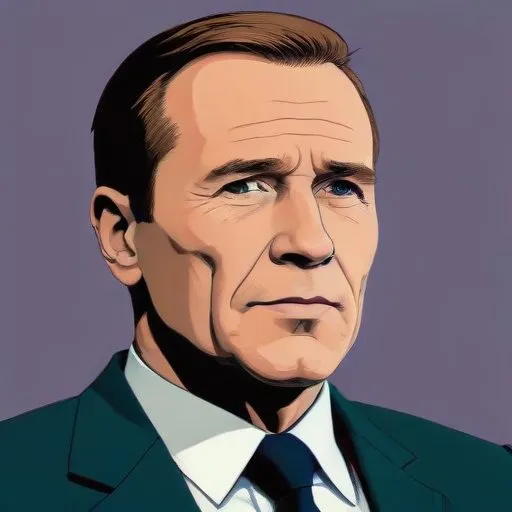
Estonian agronomist and politician who served as President of Estonia from 2001 to 2006, known for his efforts to modernize the country's agriculture and strengthen its economy. He played a key role in Estonia's transition from Soviet rule to independence.
Arnold Rütel, born on May 10, 1928, is a distinguished Estonian politician who served as the third President of Estonia from 2001 to 2006. As the second president after Estonia's independence from the Soviet occupation in 1991, Rütel played a pivotal role in shaping the country's transition to democracy.
Rütel was born in Pahavalla village, Laimjala Parish, Saaremaa, Estonia, to Feodor and Juulia Rütel. He graduated from the Agricultural College in Jüneda in 1949 and went on to work as a senior agronomist in Saaremaa from 1949 to 1950. After serving his term in the Soviet Army, Rütel worked as a teacher at the Tartu School of Agricultural Mechanization from 1955 to 1957.
In 1957, Rütel was appointed as the director of the experimental farm of the Research Institute of Veterinary Medicine and Animal Husbandry. He later became the director of the Tartu Reference State Farm, a position he held until 1969. Rütel graduated from the Estonian Academy of Agriculture in 1964 and went on to serve as the rector of the Estonian Academy of Agriculture from 1969 to 1977.
Rütel's political career began in 1983, when he was appointed as the chairman of the Presidium of the Supreme Soviet of the Estonian SSR, making him one of the 15 deputy chairmen of the Supreme Soviet of the Soviet Union. In 1990, he was elected as the Chairman of the Supreme Council, a position he held until Estonia restored its independence on August 20, 1991.
Rütel served as the President of Estonia from 2001 to 2006, during which he worked towards strengthening the country's economy and international relations. His presidency was marked by efforts to promote Estonia's integration into the European Union and NATO. Rütel also played a key role in shaping the country's foreign policy and national security strategy.
Arnold Rütel's contributions to Estonia's transition to democracy and his commitment to public service have left a lasting impact on the country. His leadership and vision have inspired generations of Estonians, and his legacy continues to shape the country's politics and society today.
Rütel's story serves as a testament to the power of dedication, perseverance, and commitment to public service. His unwavering leadership and vision have made him an unforgettable figure in Estonian history, and his contributions will continue to inspire future generations of leaders and citizens alike.
97 Years Old
Estonian filmmaker and statesman who served as the country's president from 1992 to 2001, known for his efforts to integrate Estonia into the European Union and NATO. He was also a prolific writer and director, producing several documentaries and feature films.
66 Years Old
Estonian historian and politician who served as Prime Minister of Estonia, leading the country's transition from Soviet rule to independence and implementing free-market reforms. He's known for his role in Estonia's rapid modernization and digitalization.
78 Years Old
The first Estonian to hold a high-ranking position in the European Commission, known for his efforts to modernize and integrate Estonia into the European Union. He played a key role in Estonia's accession to the EU and the eurozone.
70 Years Old
Estonia's first Prime Minister to serve two consecutive terms, he led the country's digital revolution, making Estonia a global leader in e-government and digital innovation.
72 Years Old
A Swedish-Estonian journalist and politician who served as the 4th President of Estonia, known for his efforts to promote e-government and digitalization in the country. He's a strong advocate for a free and open internet.
56 Years Old
The first female President of Estonia, serving from 2016 to 2021, known for her strong advocacy for climate action, digitalization, and e-government. She has been a vocal critic of authoritarianism and a champion of liberal democracy.
48 Years Old
The 42nd Mayor of Tallinn, Estonia's capital, who served from 2005 to 2007 and later became the country's Prime Minister from 2016 to 2021, known for his efforts to strengthen Estonia's economy and digital infrastructure.
47 Years Old
The 16th Prime Minister of Estonia, serving from 2014 to 2016, known for his efforts to modernize the country's economy and digital infrastructure. He's also a strong advocate for e-government and digitalization.
