


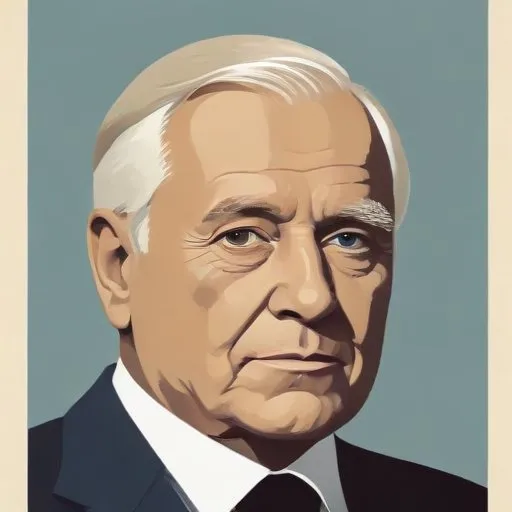
Estonian filmmaker and statesman who served as the country's president from 1992 to 2001, known for his efforts to integrate Estonia into the European Union and NATO. He was also a prolific writer and director, producing several documentaries and feature films.
Lennart Meri, the celebrated Estonian writer, film director, and statesman, is best known for his remarkable journey as the country's foreign minister from 1990 to 1992 and President of Estonia from 1992 to 2001. Through his multifaceted career, Meri left an indelible mark on Estonian politics, culture, and society, cementing his status as a national icon.
Meri was born on March 29, 1929, in Tallinn, Estonia, to Georg Meri, an Estonian diplomat and Shakespeare translator, and Alice-Brigitta Engmann, an Estonian-Swedish mother. His family's diplomatic postings allowed Meri to study in nine different schools, mastering four languages: Estonian, Finnish, French, and German.
The Soviet Union's invasion of Estonia in 1940 forced the Meri family into exile, where they were deported to Siberia along with thousands of other Estonians, Latvians, and Lithuanians. During this period, Meri worked as a lumberman, potato peeler, and rafter to support his family. It was during this time that he developed a fascination with the Finno-Ugric languages, a theme that would permeate his future work.
Meri graduated cum laude from the University of Tartu's Faculty of History and Languages in 1953. He went on to become a prominent writer, film director, and statesman, producing works that explored Estonia's cultural heritage and its relationship with the Finno-Ugric world.
Meri's entry into politics began in 1990, when he became Estonia's foreign minister, playing a pivotal role in the country's struggle for independence from Soviet rule. In 1992, he was elected as the second President of Estonia, a position he held until 2001. During his presidency, Meri worked tirelessly to promote Estonian integration into the European Union and NATO.
Meri's work was deeply influenced by his fascination with the Finno-Ugric world and Estonia's cultural heritage. He believed in the importance of preserving and promoting Estonia's unique identity in the face of globalization. His philosophical contributions lie in his ability to bridge the cultural divide between Estonia and the rest of Europe.
Meri's personal life was marked by significant milestones, including his marriage to Regina Meri in 1953 and his proposal to her on the day of Joseph Stalin's death. He also had a deep affection for the Lyce Janson de Sailly in Paris, where he spent some of his most formative years.
Meri's legacy extends far beyond his political and cultural achievements. He played a crucial role in shaping Estonia's modern identity, promoting the country's integration into the European Union, and fostering cultural exchange between Estonia and the rest of the world.
Meri received numerous awards and honors for his contributions to Estonian literature, film, and politics, including the Order of the National Coat of Arms (1995) and the Order of the White Rose of Finland (1995).
Lennart Meri's remarkable life and career serve as a testament to his unwavering dedication to Estonian culture and politics. As a statesman, writer, and film director, he left an indelible mark on Estonia's history, ensuring his legacy as a national hero and a champion of cultural preservation.
98 Years Old
Estonian agronomist and politician who served as President of Estonia from 2001 to 2006, known for his efforts to modernize the country's agriculture and strengthen its economy. He played a key role in Estonia's transition from Soviet rule to independence.
72 Years Old
A Swedish-Estonian journalist and politician who served as the 4th President of Estonia, known for his efforts to promote e-government and digitalization in the country. He's a strong advocate for a free and open internet.
56 Years Old
The first female President of Estonia, serving from 2016 to 2021, known for her strong advocacy for climate action, digitalization, and e-government. She has been a vocal critic of authoritarianism and a champion of liberal democracy.
66 Years Old
Estonian historian and politician who served as Prime Minister of Estonia, leading the country's transition from Soviet rule to independence and implementing free-market reforms. He's known for his role in Estonia's rapid modernization and digitalization.
70 Years Old
Estonia's first Prime Minister to serve two consecutive terms, he led the country's digital revolution, making Estonia a global leader in e-government and digital innovation.
78 Years Old
The first Estonian to hold a high-ranking position in the European Commission, known for his efforts to modernize and integrate Estonia into the European Union. He played a key role in Estonia's accession to the EU and the eurozone.
83 Years Old
Estonian physician and politician who served as the Minister of Health and Labour from 1999 to 2002, known for his healthcare reforms and contributions to Estonia's EU accession.
48 Years Old
The 42nd Mayor of Tallinn, Estonia's capital, who served from 2005 to 2007 and later became the country's Prime Minister from 2016 to 2021, known for his efforts to strengthen Estonia's economy and digital infrastructure.
