


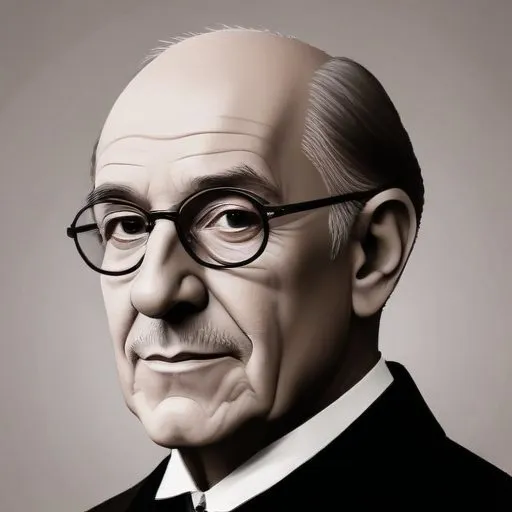
A prominent composer and educator, he was a key figure in shaping American modernist music, known for his innovative and eclectic style.
Arthur Berger was an American composer and music critic, best known for his unique style, which has been described as New Mannerist. Born on May 15, 1912, in New York City, Berger's contributions to the music world are still revered today.
Berger's teaching career spanned several institutions, including:
Berger's influence extended to his students, who include:
Berger also cofounded Perspectives of New Music with Benjamin Boretz in 1962, which he edited until 1964.
Berger's writings on music theory and criticism showcase his keen intellect and unique perspective. He coined the terms "octatonic scale" and "pitch centricity" in his seminal work, Problems of Pitch Organization in Stravinsky.
Berger's work has had a lasting impact on the music world. He was elected a Fellow of the American Academy of Arts and Sciences in 1971, and his book on Aaron Copland was reprinted in 1990 by Da Capo Press.
Berger's music is characterized by its preoccupation with vertical and horizontal musical space. His influences include Igor Stravinsky, Arnold Schoenberg, and Anton Webern.
His early works, such as the Serenade Concertante (1944) and Three Pieces for Strings (1945), exhibit a neoclassical style. In the 1950s, he began to experiment with the twelvetone technique, later moving away from serialism towards a more nuanced approach that incorporated tone cluster cells.
George Perle has praised Berger's "keen and sophisticated musical intellect," noting that his serial music was "as far removed from current fashionable trends as his diatonic music was a few years ago."
Berger's contributions to music theory, criticism, and composition continue to inspire and influence musicians and scholars today. His legacy is a testament to the power of innovative thinking and artistic expression.
Born in 1900
A renowned composer, conductor, and educator who blended folk and modernist elements to create iconic American classical music, including "Appalachian Spring" and "Fanfare for the Common Man".
Born in 1918
A renowned musician who blended jazz, classical, and Broadway styles, creating iconic works like West Side Story, and inspiring generations with his charismatic performances and innovative compositions.
Born in 1882
A Russian master of music, renowned for revolutionizing classical music with bold, avant-garde compositions that blended traditional and modern elements. His iconic works, such as "The Rite of Spring," continue to inspire and influence artists across genres.
Born in 1908
A pioneering composer of modern classical music, known for his complex and innovative works that pushed the boundaries of harmony and rhythm.
Born in 1910
A renowned pianist and composer who blended romanticism and modernism, creating iconic works like "Adagio for Strings" that evoke powerful emotions.
Born in 1910
A renowned composer and educator, he was the first president of the Juilliard School and won the Pulitzer Prize for Music in 1943. He's known for his contributions to American classical music.
Born in 1894
A renowned composer, theorist, and academic who made significant contributions to the development of American classical music, particularly in the realm of harmony and counterpoint.
Born in 1896
A renowned composer, conductor, and educator who made significant contributions to American classical music, particularly through his Romantic-style symphonies and leadership of the Eastman School of Music.
