


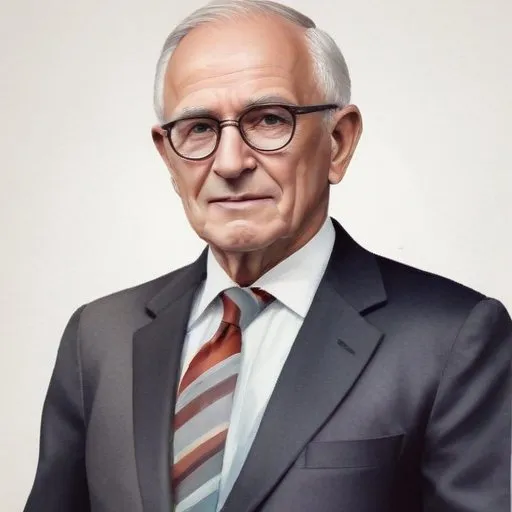
Developed the "misery index" to measure economic performance and served as Chairman of the Council of Economic Advisers under President Lyndon B. Johnson. Known for his work on macroeconomics and econometrics.
Arthur Melvin Okun, a renowned American economist, is best known for his groundbreaking work on Okun's Law, a concept that reveals the inverse relationship between unemployment rates and a country's GDP. Additionally, he is credited with creating the misery index, a metric that combines unemployment and inflation rates to gauge economic wellbeing.
Born on November 28, 1928, Okun grew up to excel academically, earning the Albert Asher Green Memorial Prize for the highest GPA upon graduating from Columbia College in 1949. He went on to pursue his Ph.D. in economics from Columbia University, which he completed in 1956.
Okun's illustrious career saw him hold various prestigious positions, including professor at Yale University and fellow at the Brookings Institution in Washington, D.C. In 1968, he was elected as a Fellow of the American Statistical Association, a testament to his contributions to the field of economics.
Okun's most notable appointment was as the chairman of the Council of Economic Advisers between 1968 and 1969. During this tenure, he played a crucial role in shaping the economic policies of the United States.
Okun's most iconic work is undoubtedly Okun's Law, which posits that for every 1% increase in the unemployment rate, a country's GDP will be roughly 2.5% lower than its potential GDP. His work on the misery index, which combines unemployment and inflation rates, has become a benchmark for measuring economic performance.
Okun's creative approach to economics is evident in his analogy of the deadweight loss of taxation, which he likened to a leaky bucket. This innovative thinking has helped make complex economic concepts more accessible to a broader audience.
Okun's contributions to economics were recognized through various honors, including his election as a Fellow of the American Statistical Association in 1968.
Arthur Okun's work continues to influence economists and policymakers worldwide. His legacy is a testament to the power of innovative thinking in shaping our understanding of the economy and its intricacies.
Okun's life was cut short when he passed away on March 23, 1980, due to a heart attack. His passing marked the loss of a brilliant mind, but his work remains an enduring tribute to his contributions to the field of economics.
Born in 1912
A Nobel Prize-winning economist who championed free market capitalism and limited government intervention, known for his advocacy of laissez-faire economics and influential writings on monetary policy.
Born in 1915
A renowned economist and academic who made significant contributions to the field of economics, particularly in the areas of macroeconomics and international trade. He was awarded the Nobel Prize in Economics in 1970.
Born in 1883
A pioneering economist who revolutionized modern economic theory with his groundbreaking ideas on government intervention and fiscal policy, shaping global economic policies.
Born in 1926
Former Chairman of the Federal Reserve, guiding the US economy through periods of growth and crisis, and known for his influence on monetary policy.
72 Years Old
The Chairman of the Federal Reserve during the 2008 financial crisis, credited with implementing unconventional monetary policies to stabilize the economy. Known for his calm and decisive leadership during tumultuous times.
71 Years Old
A renowned economist and academic who served as the Chief Economist of the World Bank and Secretary of the Treasury, known for his influential economic policies and theories.
79 Years Old
The 22nd United States Secretary of Labor, a prominent economist and politician, is most known for championing workers' rights and advocating for economic policies that benefit the middle and working classes. They are a vocal critic of income inequality and a strong proponent of progressive economic reforms.
83 Years Old
A Nobel Prize-winning economist and academic who has made significant contributions to the field of economics, particularly in the areas of information economics and globalization.
