


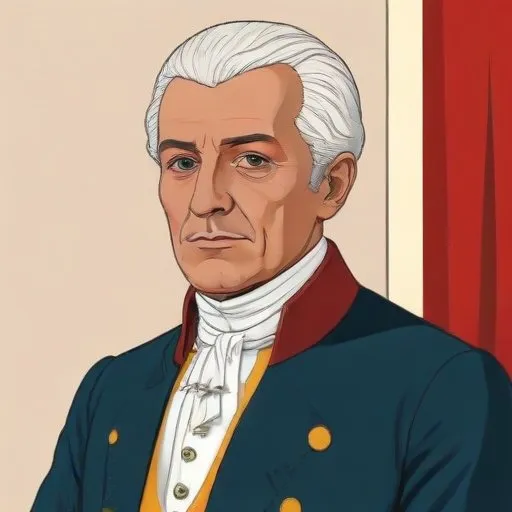
A French nobleman and politician who served as a trusted advisor to King Francis I of France, known for his diplomatic skills and involvement in key international negotiations.
Artus Gouffier, Lord of Boissy, was a prominent French nobleman and politician who left an indelible mark on French history. As the Duke of Roannez, Pair de France, Count of Tampes, and Lord of numerous other territories, Gouffier's influence extended far and wide, shaping the course of Renaissance-era France.
Born on September 6, 1474, in Montpellier, Gouffier was the eldest son of Guillaume Gouffier de Boisy, Seneschal of Saintonge, and Philippine de Montmorency. He began his court career as a page to Charles VIII, a position that allowed him to accompany the king on his conquest of the Kingdom of Naples in 1495. This experience laid the foundation for Gouffier's future diplomatic endeavors.
Gouffier's reputation as a skilled diplomat and strategist earned him the position of Grand Master of France in January 1515. During his tenure, he worked tirelessly to negotiate a lasting peace between France and the House of Habsburg, a feat that unfortunately remained incomplete at the time of his untimely death in 1519.
Gouffier's passion for architecture and construction is evident in the numerous projects he undertook during his lifetime. At the Château d'Oiron, he commissioned the construction of a grand gallery and the Saint-Maurice collegiate church, which was completed after his death by his wife. The church still houses his tomb effigy today, a testament to his enduring legacy.
In February 1499, Gouffier married Hélène d'Hangest, daughter of Jacques de Hangest, Seigneur de Genlis. The couple had three children: two daughters, Hélène and Anne, and one son, Claude Gouffier, who succeeded his father as Grand Squire of France.
Artus Gouffier, Lord of Boissy, left an indelible mark on French history, politics, and architecture. His diplomatic efforts, though cut short by his untimely death, paved the way for future generations of French leaders. His architectural legacy continues to inspire awe, while his family's lasting impact on French nobility remains a testament to his enduring influence.
Born in 1519
King of France from 1547 to 1559, known for his cultural and artistic patronage, and his role in the Italian Wars.
Born in 1757
The last Bourbon king of France, ruling from 1824 to 1830, known for his ultra-royalist views and attempts to restore absolute monarchy, leading to the July Revolution.
Born in 1519
King of France from 1547 to 1559, known for his cultural and artistic patronage, and his role in the Italian Wars.
Born in 1519
King of France from 1547 to 1559, known for his cultural and artistic patronage, and his role in the Italian Wars.
Born in 1785
The last king of the French monarchy before the French Revolution, known for his tragic and mysterious life, including his imprisonment and disputed death.
Born in 1585
A powerful and cunning statesman who dominated French politics during the 17th century, known for his ruthless suppression of dissent and centralization of power. He was a master strategist and diplomat who shaped the course of European history.
