


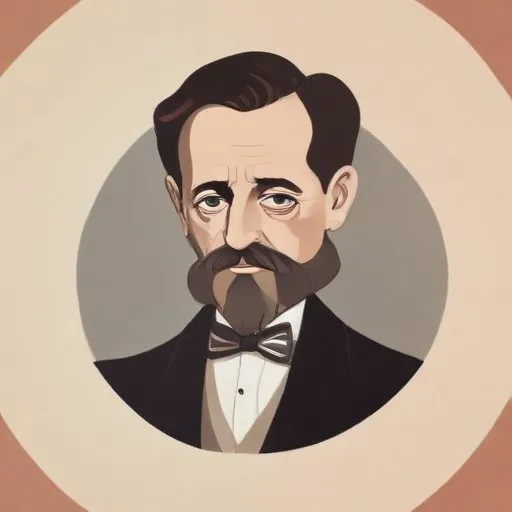
A 17th-century philosopher and academic who contributed to the development of modern philosophy, particularly in the fields of metaphysics and epistemology. He's known for his work on the nature of knowledge and reality.
AugusteThéodorePaul de Broglie was a renowned French priest, professor, and writer who dedicated his life to defending the Catholic faith against the attacks of Positivism and Rationalism. He is best known for his tireless efforts to promote the harmony and autonomy of faith and reason, earning him a revered place in the annals of Catholic apologetics.
Born on June 18, 1834, into a noble family, de Broglie was the son of Achille-Victor, Duc de Broglie, and his wife, Albertine, baroness Stal von Holstein. Following his mother's untimely death, he was raised by his aunt, Baroness Auguste de Stal, who, despite being a Protestant, instilled in him a strong Christian upbringing.
De Broglie's early years were marked by a sense of adventure and service. He studied at the prestigious École Polytechnique, graduating in 1855, and later joined the navy, where he was appointed ensign in 1857 and lieutenant soon after. A voyage to New Caledonia in 1867 brought him into contact with active missions, sparking a deep sense of calling to the religious life.
In 1867, de Broglie entered the Seminary of Saint Sulpice in Paris, marking the beginning of his journey as a priest. Ordained on October 18, 1870, he went on to become a professor of apologetics at the Institut Catholique in 1879. His teachings, which spanned philosophical, theological, biblical, and historical themes, were designed to counter the perceived threats of Positivism and Rationalism to the Catholic faith.
De Broglie was a prolific writer, and his numerous publications consistently defended Catholic dogma. Some of his notable works include:
Tragically, de Broglie's life was cut short when he was attacked by an insane person he had taken under his protection. He passed away on May 11, 1895, leaving behind a rich legacy of scholarship and devotion. His unwavering commitment to defending the Catholic faith continues to inspire generations of theologians, philosophers, and apologists.
AugusteThéodorePaul de Broglie's remarkable life serves as a testament to the power of faith, reason, and dedication. Through his teachings, writings, and service, he has left an indelible mark on the world of Catholic apologetics. As we reflect on his life and legacy, may we be inspired to emulate his passion for defending the faith and promoting the harmony of reason and faith.
Born in 1694
A witty and insightful 18th-century writer and philosopher who used satire to critique societal norms and advocate for reason, tolerance, and human rights.
Born in 1689
A French lawyer and philosopher who developed the concept of separation of powers, which divides a government into legislative, executive, and judicial branches to prevent abuse of power. His ideas greatly influenced modern democracy.
Born in 1712
A pioneering thinker who shaped modern democracy and education with his ideas on social contracts, general will, and the importance of early childhood education. His writings influenced the French Revolution and modern political thought.
Born in 1724
Developed influential philosophical frameworks, such as the Critique of Pure Reason, that shaped modern Western thought on ethics, morality, and human understanding.
Born in 1770
A German philosopher and academic who developed a comprehensive and systematic philosophy that emphasized the unity of all things and the dialectical process of thesis, antithesis, and synthesis. His ideas have had a profound impact on modern thought, influencing fields such as philosophy, politics, and art.
Born in 1788
A pessimistic philosopher who wrote about the human condition, emphasizing the struggles and sufferings of life, and is famous for his concept of the "will to life".
