


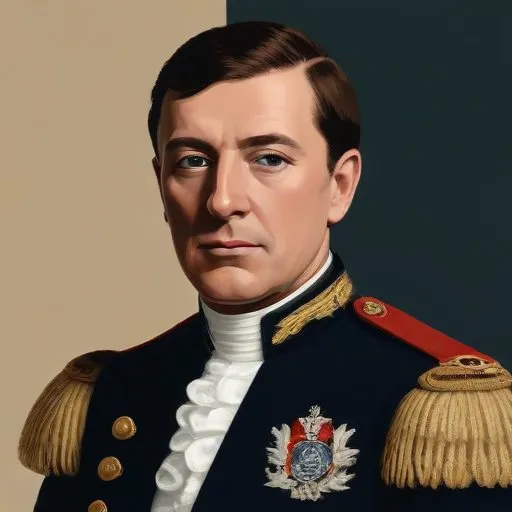
A British naval officer and politician who played a key role in 18th-century Irish politics, serving as Chief Secretary for Ireland and contributing to significant policy reforms.
Meet Augustus Hervey, 3rd Earl of Bristol, a British naval officer and politician who left an indelible mark on history with his bravery, strategic prowess, and scandalous personal life. Known as the "English Casanova," Hervey's exploits on the high seas and in the corridors of power are the stuff of legend.
Born on May 19, 1724, as the second son of John, Lord Hervey, Augustus was educated at Westminster School from 1733. He entered the Royal Navy in 1735, at the tender age of 11, and quickly rose through the ranks.
Promoted to lieutenant in 1740, Hervey saw action in several key battles, including the Battle of Minorca in 1756, where he commanded the sixth-rate HMS Phoenix. He later commanded the third-rate HMS Dragon, playing a crucial role in the Capture of Belle Île in 1761, the Invasion of Martinique in 1762, and the Battle of Havana in 1762.
Hervey's bravery and tactical genius earned him recognition from his superiors, including Admiral Hawke, with whom he worked closely during the Seven Years' War. He continued to serve with distinction, commanding various ships, including the fourth-rate HMS Centurion, before his active life at sea ceased in 1763.
In addition to his naval exploits, Hervey was a skilled politician, serving as Member of Parliament for several constituencies. He was appointed Chief Secretary for Ireland and later became First Naval Lord, where he oversaw the British Navy's operations and strategy.
Hervey's personal life was as colorful as his professional one. He was known for his numerous romantic conquests, earning him the sobriquet "English Casanova." His scandals and love affairs were the subject of much gossip and intrigue, adding to his already larger-than-life reputation.
Despite his personal controversies, Hervey left a lasting legacy in the British Navy and politics. He was promoted to vice-admiral in 1778, a testament to his dedication and service to his country.
Today, Augustus Hervey, 3rd Earl of Bristol, is remembered as a true British hero, whose bravery, strategic prowess, and, yes, colorful personal life, continue to fascinate historians and enthusiasts alike.
Augustus Hervey, 3rd Earl of Bristol, may have lived a life of controversy and scandal, but his bravery, strategic brilliance, and dedication to his country have cemented his place as one of the most fascinating figures in British history.
Born in 1690
A prominent 18th-century politician who served as Lord President of the Council, playing a significant role in British politics and governance. He's known for his influential decisions and leadership during a tumultuous period in British history.
Born in 1693
A dominant figure in 18th-century British politics, he served as Prime Minister of Great Britain twice, playing a significant role in shaping the country's foreign policy and governance.
Born in 1705
A prominent 18th-century politician who served as Secretary of State for the Southern Department, playing a significant role in shaping British foreign policy during the American Revolutionary War. He was a skilled orator and influential Whig leader.
Born in 1683
King of Great Britain and Ireland from 1727 to 1760, known for his military victories, particularly the Battle of Dettingen, and his role in the War of the Austrian Succession.
Born in 1726
A renowned British naval officer and politician who played a key role in the American Revolutionary War and later became Treasurer of the Navy, known for his tactical genius and bravery at sea.
Born in 1735
A renowned naval commander who led British fleets to several victories during the French Revolutionary and Napoleonic Wars, earning him great acclaim and a peerage. He also served as First Lord of the Admiralty, implementing significant naval reforms.
