


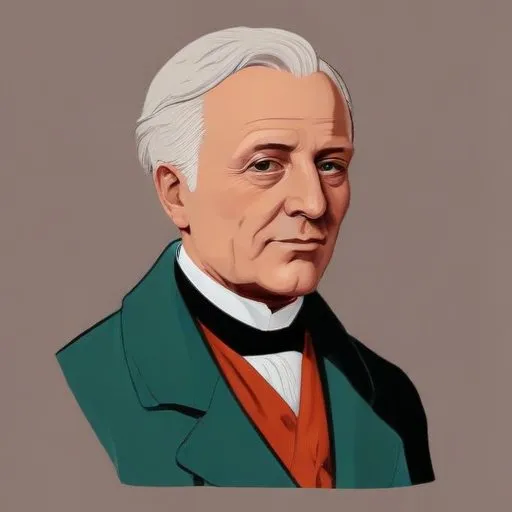
German physician and botanist who contributed significantly to the field of botany, particularly in the classification and naming of plants. His work laid the foundation for later botanists, including Carolus Linnaeus.
Augustus Quirinus Rivinus, a 17th-century German physician and botanist, is renowned for his groundbreaking contributions to the field of botany, particularly in the area of plant classification. His innovative approach, which emphasized the structure of flowers, paved the way for future botanists, including Joseph Pitton de Tournefort and Carl Linnaeus, to build upon his work.
Rivinus was born on December 9, 1652, in Leipzig, Germany. He pursued his studies at the University of Leipzig from 1669 to 1671 and later at the University of Helmstedt, where he earned his M.D. in 1676.
Rivinus's academic career was marked by several notable milestones. In 1677, he began lecturing in medicine at the University of Leipzig, and in 1691, he was appointed to two chairs, one in physiology and the other in botany. Additionally, he became the curator of the University's medical garden. Over the years, he held various positions, including professor of pathology (1701) and professor of therapeutics (1719), and was appointed as the permanent dean of the Faculty of Medicine.
One of Rivinus's most significant contributions was his work on plant classification. In his book, Introductio generalis in rem herbariam, he introduced several innovative approaches, including the use of dichotomous keys and the classification of plants based on the structure of their flowers. This approach was later adopted by other botanists, who built upon his work.
Rivinus's work on plant classification was characterized by several key innovations. He was one of the first botanists to consistently apply the rule that the names of all species within a genus should start with the same word (generic name). If a genus contained only one species, the generic name would be its only name. If there were multiple species within a genus, their names would consist of the generic name followed by differentia specifica, a brief diagnostic phrase.
Rivinus's contributions to botany had a lasting impact on the field. His work influenced prominent botanists, including Joseph Pitton de Tournefort and Carl Linnaeus, who built upon his classification systems. Today, Rivinus is recognized as a pioneer in the field of botany, and his work remains an important foundation for modern plant classification systems.
Despite his many achievements, Rivinus faced personal challenges. His interest in astronomy led to his observation of sunspots, which ultimately resulted in his near-complete blindness by the last decade of his life (around 1713).
Rivinus passed away on December 20, 1723, in Leipzig, Germany, leaving behind a lasting legacy in the field of botany.
Born in 1707
Developed the system of binomial nomenclature, which is still used today to classify and name living organisms. This system has had a profound impact on the fields of biology, ecology, and conservation.
Born in 1744
A French soldier, biologist, and academic who developed a theory of inheritance of acquired characteristics, proposing that organisms adapt to their environment and pass on those traits to their offspring.
Born in 1769
Founded the field of comparative anatomy, establishing extinction as a fact and creating a framework for understanding the natural world through fossil records.
82 Years Old
A German-Canadian singer-songwriter, guitarist, and producer, known for his eclectic style blending rock, folk, and blues, and as the frontman of the rock band Steppenwolf. He's famous for hits like "Born to Be Wild" and "Magic Carpet Ride".
Born in 1632
Pioneering microbiologist who discovered microorganisms like bacteria, yeast, and protists, laying the foundation for modern microbiology.
Born in 1514
A pioneering figure in the study of human anatomy, known for performing detailed dissections and creating accurate drawings of the body's inner workings, revolutionizing medical understanding.
Born in 1668
A Dutch botanist and physician who laid the foundations for modern medicine by emphasizing clinical observation, experimentation, and scientific rigor, and is considered the father of physiology.
